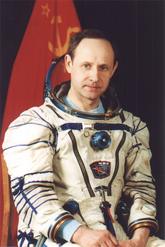
Anatoly Artsebarsky
Russian - (RFSA)
Retired
Date of Birth: Sept. 9, 1956
Age: 69
Anatoly Pavlovich Artsebarsky (Ukrainian: Анатолій Павлович Арцебарський) (Russian: Анатолий Павлович Арцебарский; born 9 September 1956) is a former Soviet cosmonaut. He became a cosmonaut in 1985. Artsebarsky has spent almost 5 months in space on a single spaceflight. In 1991, he flew aboard Soyuz TM-12 and docked with the Mir Space Station. Artsebarsky and Sergei Krikalev stayed aboard Mir while the rest of the crew flew back to Earth after eight days. Artsebarsky took six spacewalks during the Mir EO-9 mission. He spent over 33 hours walking in space.
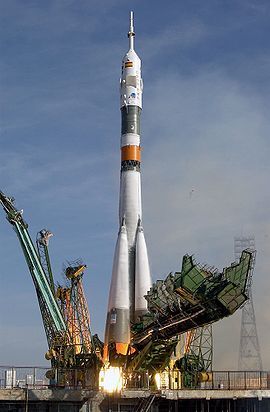
Soyuz-U2 | Soyuz TM-12
Soviet Space Program | RussiaBaikonur Cosmodrome, Republic of Kazakhstan
May 18, 1991, 12:50 p.m.
Status: Success
Mission:
Soyuz TM-12 was the 12th mission and the ninth long-duration expedition to Mir space station. The mission began on May 18, 1991, 12:50:28 UTC, launching Commander Anatoly Artsebarsky, Flight Engineer Sergei Krikalyov and Research Cosmonaut Helen Sharman, the first British cosmonaut, into orbit. They docked with Mir two days later. During their stay there, cosmonauts performed EVAs, various station repair and maintenance tasks, and carried out scientific experiments in biology, geophysics, space technology, astronomy etc. They were visited by several Progress resupply spacecrafts and welcomed aboard the Soyuz TM-13 crew. Helen Sharman returned on May 26, 1991, in Soyuz TM-11 spacecraft. While Sergei Krikalyov stayed on the station as a part of the next long-duration expedition, Anatoly Artsebarsky landed safely back on Earth on October 10, 1991, 04:12:18 UTC.
Low Earth OrbitThe Roscosmos State Corporation for Space Activities, commonly known as Roscosmos, is the governmental body responsible for the space science program of the Russian Federation and general aerospace research. Soyuz has many launch locations the Russian sites are Baikonur, Plesetsk and Vostochny however Ariane also purchases the vehicle and launches it from French Guiana.
Falcon 9
Starlink Group 17-22
Space Launch Complex 4E - Vandenberg SFB, CA, USAA batch of 25 satellites for the Starlink mega-constellation - SpaceX's project for space-based Internet communication system.
New Glenn
BlueBird Block 2 #2
Launch Complex 36A - Cape Canaveral SFS, FL, USAAST SpaceMobile’s Block 2 BlueBird satellites are designed to deliver up to 10 times the bandwidth capacity of the BlueBird Block 1 satellites, requi…
Long March 4C
Daqi-2 (AEMS)
Launch Area 94 (SLS-2 / 603) - Jiuquan Satellite Launch Center, People's Republic of ChinaDaqi-2 (DQ-2), also known as the Atmospheric Environment Monitoring Satellite/AEMS, is the second of follow-on series of Chinese satellites to the GF…
Soyuz 2.1b/Volga
Kosmos (Unknown Payload)
43/4 (43R) - Plesetsk Cosmodrome, Russian FederationUnknown satellite(s) for the Russian military.
Falcon 9
Starlink Group 17-27
Space Launch Complex 4E - Vandenberg SFB, CA, USAA batch of 25 satellites for the Starlink mega-constellation - SpaceX's project for space-based Internet communication system.

