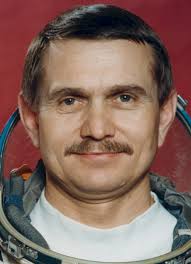
Anatoly Berezovoy
Russian - (RFSA)
Deceased
Date of Birth: April 11, 1942
Date of Death: Sept. 20, 2014
Anatoly Nikolayevich Berezovoy (Russian: Анато́лий Никола́евич Березово́й; 11 April 1942 – 20 September 2014) was a Soviet cosmonaut. On 27 April 1970 he was selected as a cosmonaut. In 1982 he flew as Commander on Soyuz T-5 on the first mission to the Salyut 7 space station, returning to Earth on the Soyuz T-7 after 211 days 9 hours. He retired on 31 October 1992 due to age. From 1992 to 1999, he was a Deputy President of Russian Space Federation.
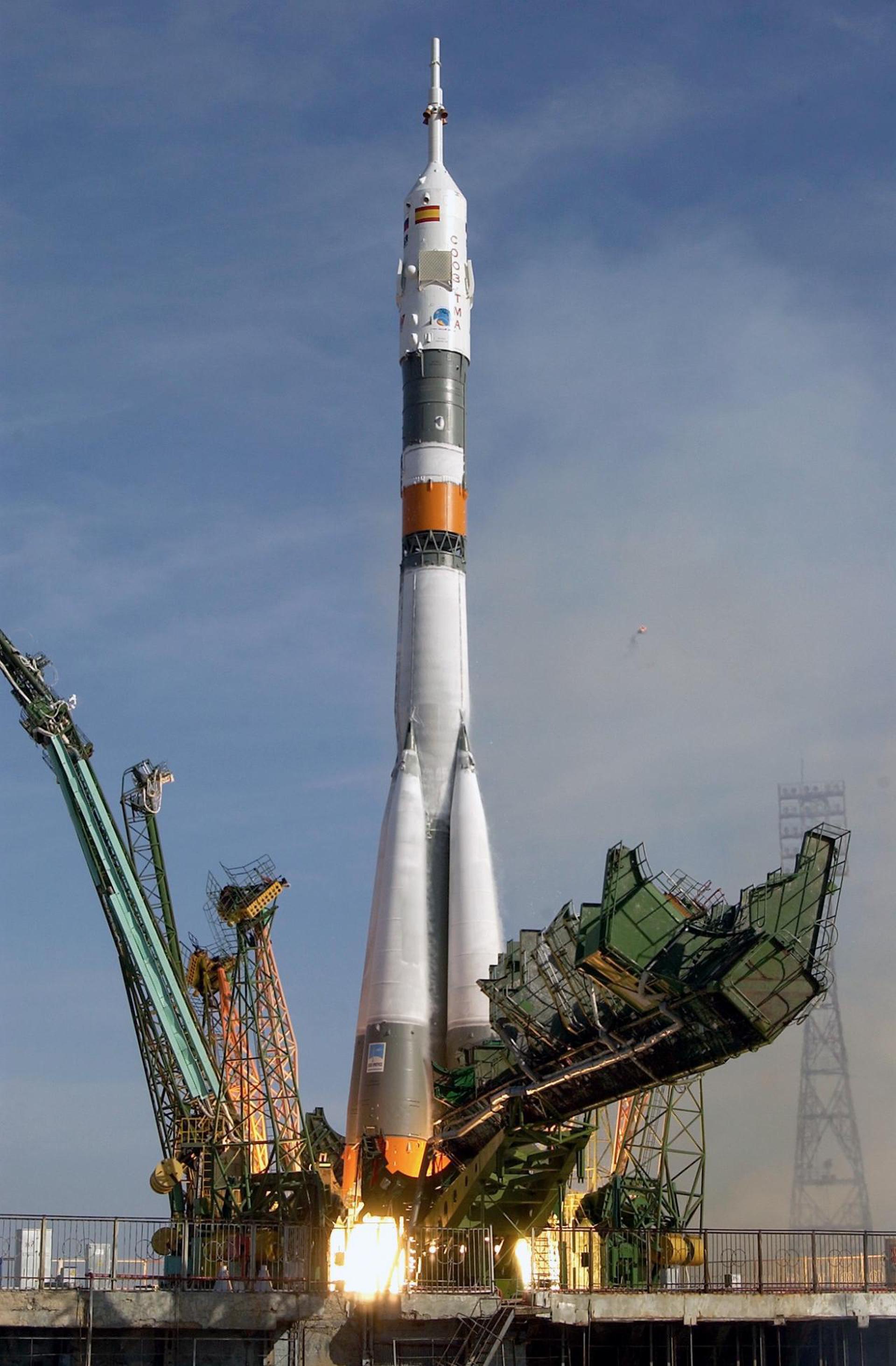
Soyuz-U | Soyuz T-5
Russian Federal Space Agency (ROSCOSMOS) | RussiaBaikonur Cosmodrome, Republic of Kazakhstan
May 13, 1982, 9:58 a.m.
Status: Success
Mission:
Soyuz T-5 was the first long-duration expedition to the Salyut 7 space station. The mission began on May 13, 1982, 09:58:05 UTC, launching Commander Anatoli Berezovoy and Flight Engineer Valentin Lebedev into orbit. They docked with the station the next day. During their 211-day stay on the station, crew performed various scientific and medical experiments, and were visited by 4 uncrewed cargo Progress vehicles and 2 Soyuz missions. Soyuz T-5 crew, per usual, swapped vehicles with the visiting Soyuz T-7 crew, which allowed for a longer stay in orbit. Cosmonauts returned in the Soyuz T-7 spacecraft, landing safely back on Earth on December 10, 1982, 19:02:36 UTC.
Low Earth OrbitSoyuz-U | Soyuz T-7
Russian Federal Space Agency (ROSCOSMOS) | RussiaBaikonur Cosmodrome, Republic of Kazakhstan
Aug. 19, 1982, 5:11 p.m.
Status: Success
Mission:
Soyuz T-7 was the third mission to the Salyut 7 space station and the second to visit the long-duration Soyuz T-5 resident crew of the station. The mission began on August 19, 1982, 17:11:52 UTC, launching Commander Leonid Popov, Flight Engineer Aleksandr Serebrov and Research Cosmonaut Svetlana Savitskaya, who was the second woman in space, 20 years after Valentina Tereshkova's flight. They docked with the station the next day. During their 7-day stay on the station, crew performed various scientific and medical experiments. Soyuz T-7, per usual, swapped their vehicles with the resident Soyuz T-5 crew, which allowed for a longer stay on the station. The crew returned in Soyuz T-5 spacecraft, landing safely back on Earth on August 27, 1982, 15:04:16 UTC.
Low Earth OrbitThe Roscosmos State Corporation for Space Activities, commonly known as Roscosmos, is the governmental body responsible for the space science program of the Russian Federation and general aerospace research. Soyuz has many launch locations the Russian sites are Baikonur, Plesetsk and Vostochny however Ariane also purchases the vehicle and launches it from French Guiana.
Falcon 9
Starlink Group 17-27
Space Launch Complex 4E - Vandenberg SFB, CA, USAA batch of 25 satellites for the Starlink mega-constellation - SpaceX's project for space-based Internet communication system.
Falcon 9
Starlink Group 10-24
Space Launch Complex 40 - Cape Canaveral SFS, FL, USAA batch of 29 satellites for the Starlink mega-constellation - SpaceX's project for space-based Internet communication system.
Kinetica 1
8 x Jilin-1
Launch Area 130 - Jiuquan Satellite Launch Center, People's Republic of China8 Earth observation satellites for the Jilin-1 commercial Earth observation satellites constellation: * High Resolution-07A 02-04 * High Resoluti…
Falcon 9
Cygnus CRS-2 NG-24 (S.S. Steven R. Nagel)
Space Launch Complex 40 - Cape Canaveral SFS, FL, USAThis is the 24th flight of the Orbital ATK's uncrewed resupply spacecraft Cygnus and its 23rd flight to the International Space Station under the Com…
Smart Dragon 3
SatNet test satellite
South China Sea (launch location 3) - Haiyang Oriental SpaceportOfficially described as "Satellite-Internet Technology Demonstration Satellite". Probable 1 (?) test satellite for the Chinese state-owned LEO commun…

