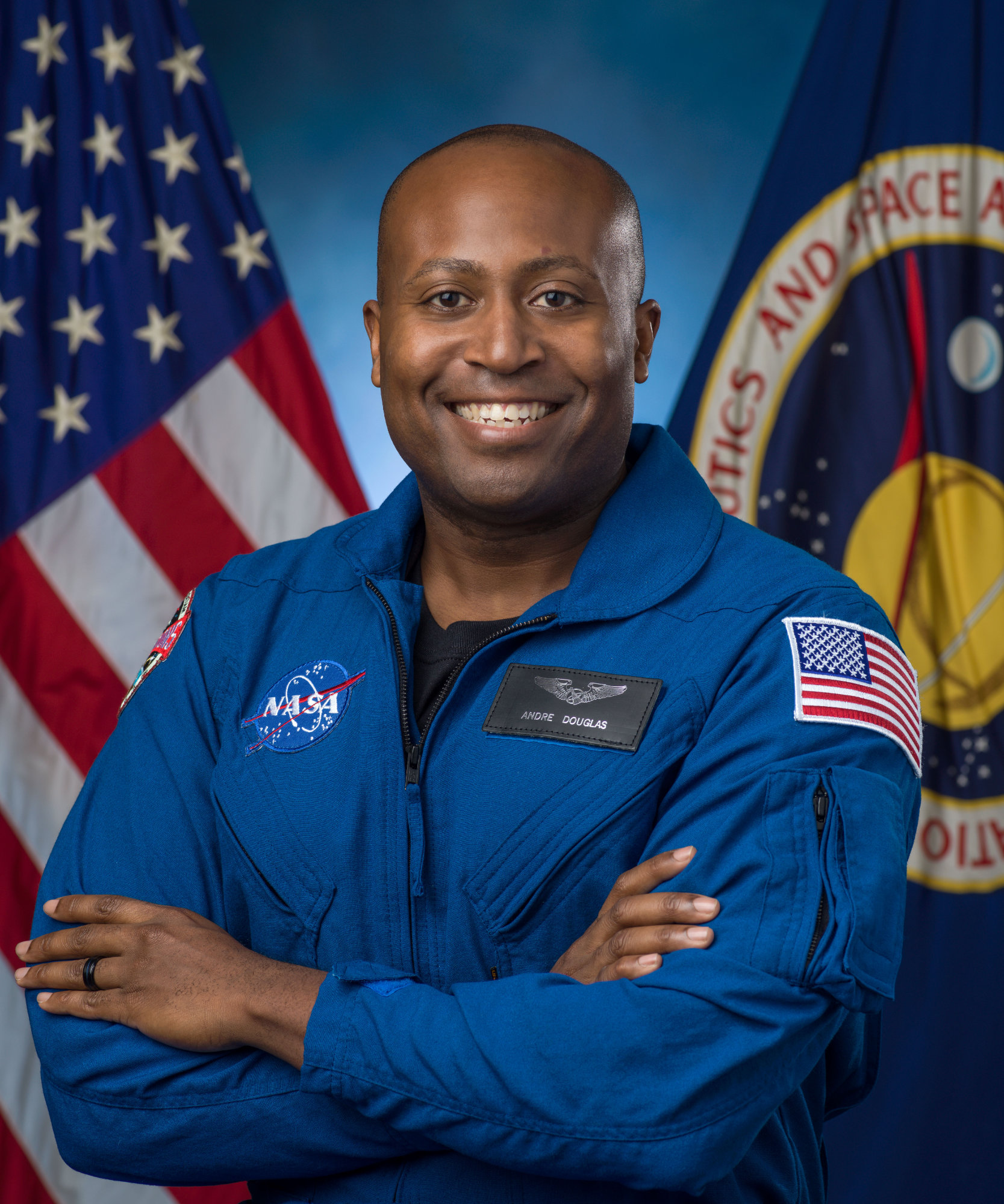
Andre Douglas
American - (NASA)
In-Training
Andre Douglas is a Virginia native. He earned a bachelor’s degree in mechanical engineering from the U.S. Coast Guard Academy, a master’s degree in mechanical engineering from the University of Michigan, a master’s degree in naval architecture and marine engineering from the University of Michigan, a master’s degree in electrical and computer engineering from Johns Hopkins University, and a doctorate in systems engineering from the George Washington University. Douglas served in the U.S. Coast Guard as a naval architect, salvage engineer, damage control assistant, and officer of the deck. He most recently was a senior staff member at the Johns Hopkins University Applied Physics Lab, working on maritime robotics, planetary defense, and space exploration missions for NASA.
Spaceflight Record
No spaceflights found for Andre Douglas.
The National Aeronautics and Space Administration is an independent agency of the executive branch of the United States federal government responsible for the civilian space program, as well as aeronautics and aerospace research. NASA have many launch facilities but most are inactive. The most commonly used pad will be LC-39B at Kennedy Space Center in Florida.
Falcon 9
Starlink Group 10-41
Space Launch Complex 40 - Cape Canaveral SFS, FL, USAA batch of 29 satellites for the Starlink mega-constellation - SpaceX's project for space-based Internet communication system.
Falcon 9
Starlink Group 17-23
Space Launch Complex 4E - Vandenberg SFB, CA, USAA batch of 25 satellites for the Starlink mega-constellation - SpaceX's project for space-based Internet communication system.
Electron
That's Not A Knife (DART AE)
Rocket Lab Launch Complex 2 (Launch Area 0 C) - Wallops Flight Facility, Virginia, USAPayload is a scramjet-powered hypersonic vehicle developed by by Australian company Hypersonix.
Falcon 9
Starlink Group 6-108
Space Launch Complex 40 - Cape Canaveral SFS, FL, USAA batch of 29 satellites for the Starlink mega-constellation - SpaceX's project for space-based Internet communication system.
Falcon 9
Starlink Group 17-26
Space Launch Complex 4E - Vandenberg SFB, CA, USAA batch of 25 satellites for the Starlink mega-constellation - SpaceX's project for space-based Internet communication system.

