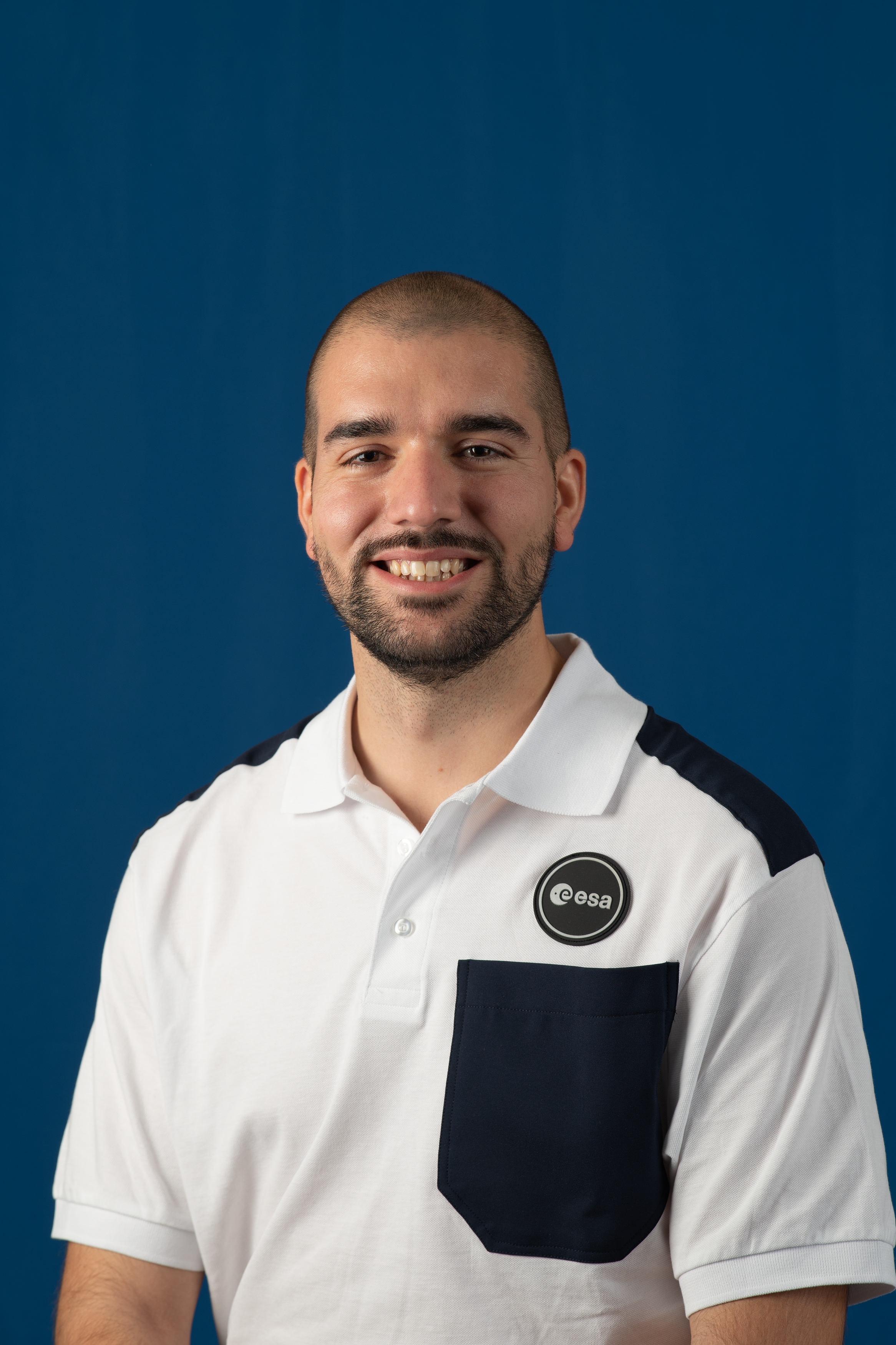
Pablo Álvarez Fernández
Spanish - (ESA)
In-Training
Pablo holds a bachelor's degree in aeronautical engineering from the University of León (Universidad de León), Spain, and graduated with a master’s degree in aerospace engineering from the Warsaw University of Technology (Politechnika Warszawska) in 2011. After graduating university, Pablo was working as a structural engineer for several aircraft programmes, such as for Airbus and Safran in Spain, the UK and France between 2011 and 2017. From 2017 to 2020, while working as an ExoMars rover mechanical architect at Airbus Defence and Space in the UK, his responsibilities included the development of the radiosotope heater unit integration procedure in conjunction with Russian Space Agency ROSCOSMOS and ESA, as well as being a test director during the environmental test campaign.
Spaceflight Record
No spaceflights found for Pablo Álvarez Fernández.
The European Space Agency is an intergovernmental organisation of 22 member states. Established in 1975 and headquartered in Paris, France, ESA has a worldwide staff of about 2,000 employees. ESA's space flight programme includes human spaceflight (mainly through participation in the International Space Station program); the launch and operation of unmanned exploration missions to other planets and the Moon; Earth observation, science and telecommunication; designing launch vehicles; and maintaining a major spaceport, the Guiana Space Centre at Kourou, French Guiana.
Long March 6A
SatNet LEO Group 21
Launch Complex 9A - Taiyuan Satellite Launch Center, People's Republic of ChinaA batch of 5 Low Earth Orbit communication satellites for the Chinese state owned SatNet constellation operated by the China Satellite Network Group.…
Long March 8
SpaceSail Polar Group 07
Commercial LC-1 - Wenchang Space Launch Site, People's Republic of China18 Low Earth Orbit communication satellites with Ku, Q and V band payloads for the G60 constellation operated by Shanghai Spacesail Technologies with…
Minotaur IV
STP-S29A
Space Launch Complex 8 - Vandenberg SFB, CA, USASTP-S29A is a mission under the U.S. Department of Defense's Space Test Program (STP) that will deliver technology demonstrations to orbit and contri…
Falcon 9
Starlink Group 17-35
Space Launch Complex 4E - Vandenberg SFB, CA, USAA batch of 25 satellites for the Starlink mega-constellation - SpaceX's project for space-based Internet communication system.
Atlas V 551
Amazon Leo (LA-05)
Space Launch Complex 41 - Cape Canaveral SFS, FL, USAAmazon Leo, formerly known as Project Kuiper, is a mega constellation of satellites in Low Earth Orbit that will offer broadband internet access, thi…

