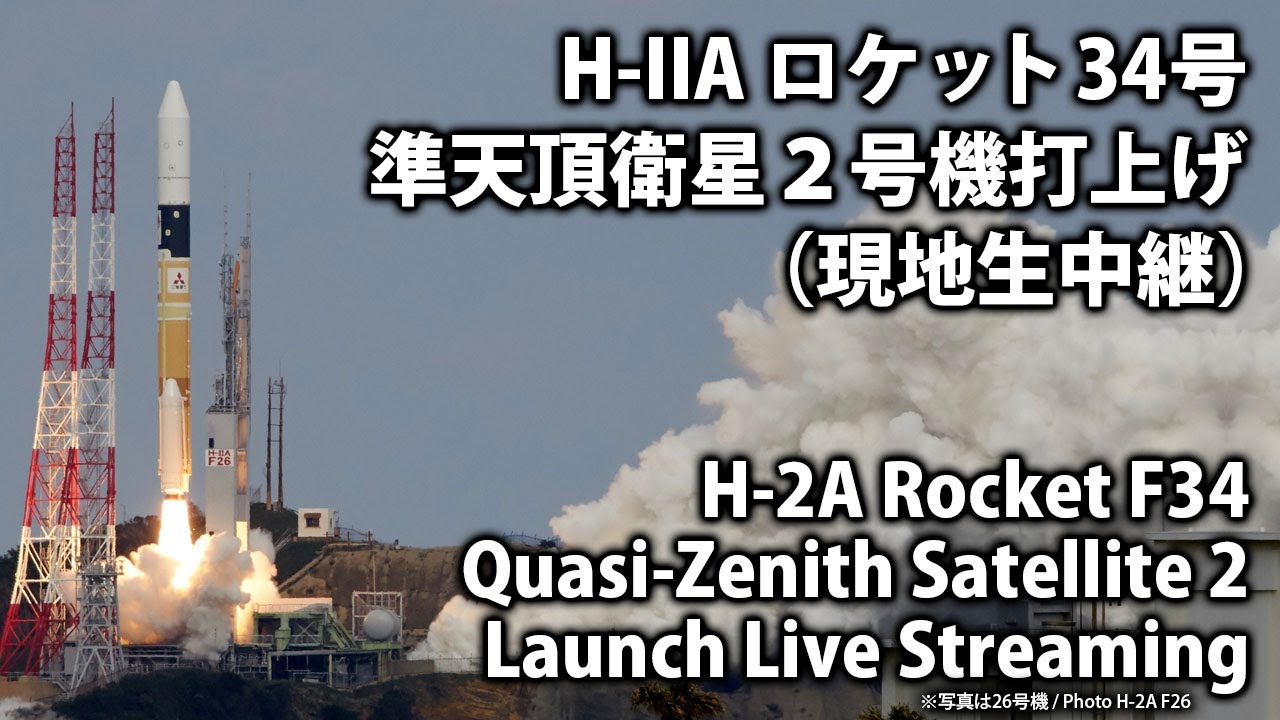
H-IIA 202 | Michibiki 2 (QZS-2)
Launch Successful
L - -- : -- : -- : --
Instantaneous launch window.
Launch Window
June 1, 2017, 12:17 a.m. - June 1, 2017, 12:17 a.m.


Instantaneous launch window.
June 1, 2017, 12:17 a.m. - June 1, 2017, 12:17 a.m.
The Quasi-Zenith Satellite System (QZSS) is a three-satellite regional time transfer system and the satellite-based augmentation system for the GPS that would be receivable within Japan. The primary purpose of QZSS is to increase the availability of GPS in Japan's numerous urban canyons, where only satellites at very high elevation can be seen. A secondary function is performance enhancement, increasing the accuracy and reliability of GPS derived navigation solutions. A single satellite weighs about 4000 kg, has an expected lifetime of 15 years and is put in a elliptical, highly inclined geosynchronous orbit.
H-IIA (H2A) is an active expendable launch system operated by Mitsubishi Heavy Industries (MHI) for the Japan Aerospace Exploration Agency. The liquid-fueled H-IIA rockets have been used to launch satellites into geostationary orbit, to launch a lunar orbiting spacecraft, and to launch Akatsuki, which studied the planet Venus. Launches occur at the Tanegashima Space Center.
Mitsubishi Heavy Industries, Ltd. is a Japanese multinational engineering, electrical equipment and electronics company headquartered in Tokyo, Japan. MHI is one of the core companies of the Mitsubishi Group. MHI's products include aerospace components, air conditioners, aircraft, automotive components, forklift trucks, hydraulic equipment, machine tools, missiles, power generation equipment, printing machines, ships and space launch vehicles. Through its defense-related activities, it is the world's 23rd-largest defense contractor measured by 2011 defense revenues and the largest based in Japan.
INFO WIKIA batch of 25 satellites for the Starlink mega-constellation - SpaceX's project for space-based Internet communication system.
A batch of 29 satellites for the Starlink mega-constellation - SpaceX's project for space-based Internet communication system.
8 Earth observation satellites for the Jilin-1 commercial Earth observation satellites constellation: * High Resolution-07A 02-04 * High Resoluti…
This is the 24th flight of the Orbital ATK's uncrewed resupply spacecraft Cygnus and its 23rd flight to the International Space Station under the Com…
Officially described as "Satellite-Internet Technology Demonstration Satellite". Probable 1 (?) test satellite for the Chinese state-owned LEO commun…
A batch of 25 satellites for the Starlink mega-constellation - SpaceX's project for space-based Internet communication system.
A batch of 5 Low Earth Orbit communication satellites for the Chinese state owned SatNet constellation operated by the China Satellite Network Group.…
18 Low Earth Orbit communication satellites with Ku, Q and V band payloads for the G60 constellation operated by Shanghai Spacesail Technologies with…
STP-S29A is a mission under the U.S. Department of Defense's Space Test Program (STP) that will deliver technology demonstrations to orbit and contri…
A batch of 25 satellites for the Starlink mega-constellation - SpaceX's project for space-based Internet communication system.