H-IIA 202 | XRISM & SLIM
Launch Successful
L - -- : -- : -- : --
Instantaneous launch window.
Launch Window
Sept. 6, 2023, 11:42 p.m. - Sept. 6, 2023, 11:42 p.m.


Instantaneous launch window.
Sept. 6, 2023, 11:42 p.m. - Sept. 6, 2023, 11:42 p.m.
X-Ray Imaging and Spectroscopy Mission (XRISM), formerly the X-Ray Astronomy Recovery Mission (XARM), is a replacement for the Hitomi satellite that malfunctioned few weeks after the launch. Smart Lander for Investigating Moon (SLIM) is a lunar probe that will target a landing on a small crater in Mare Nectaris, an area located near the moon's equator on the side facing Earth.

Launch success.
Liftoff.

Livestream has started
New launch date and time.

TBD September due to weather
H-IIA (H2A) is an active expendable launch system operated by Mitsubishi Heavy Industries (MHI) for the Japan Aerospace Exploration Agency. The liquid-fueled H-IIA rockets have been used to launch satellites into geostationary orbit, to launch a lunar orbiting spacecraft, and to launch Akatsuki, which studied the planet Venus. Launches occur at the Tanegashima Space Center.
Mitsubishi Heavy Industries, Ltd. is a Japanese multinational engineering, electrical equipment and electronics company headquartered in Tokyo, Japan. MHI is one of the core companies of the Mitsubishi Group. MHI's products include aerospace components, air conditioners, aircraft, automotive components, forklift trucks, hydraulic equipment, machine tools, missiles, power generation equipment, printing machines, ships and space launch vehicles. Through its defense-related activities, it is the world's 23rd-largest defense contractor measured by 2011 defense revenues and the largest based in Japan.
INFO WIKI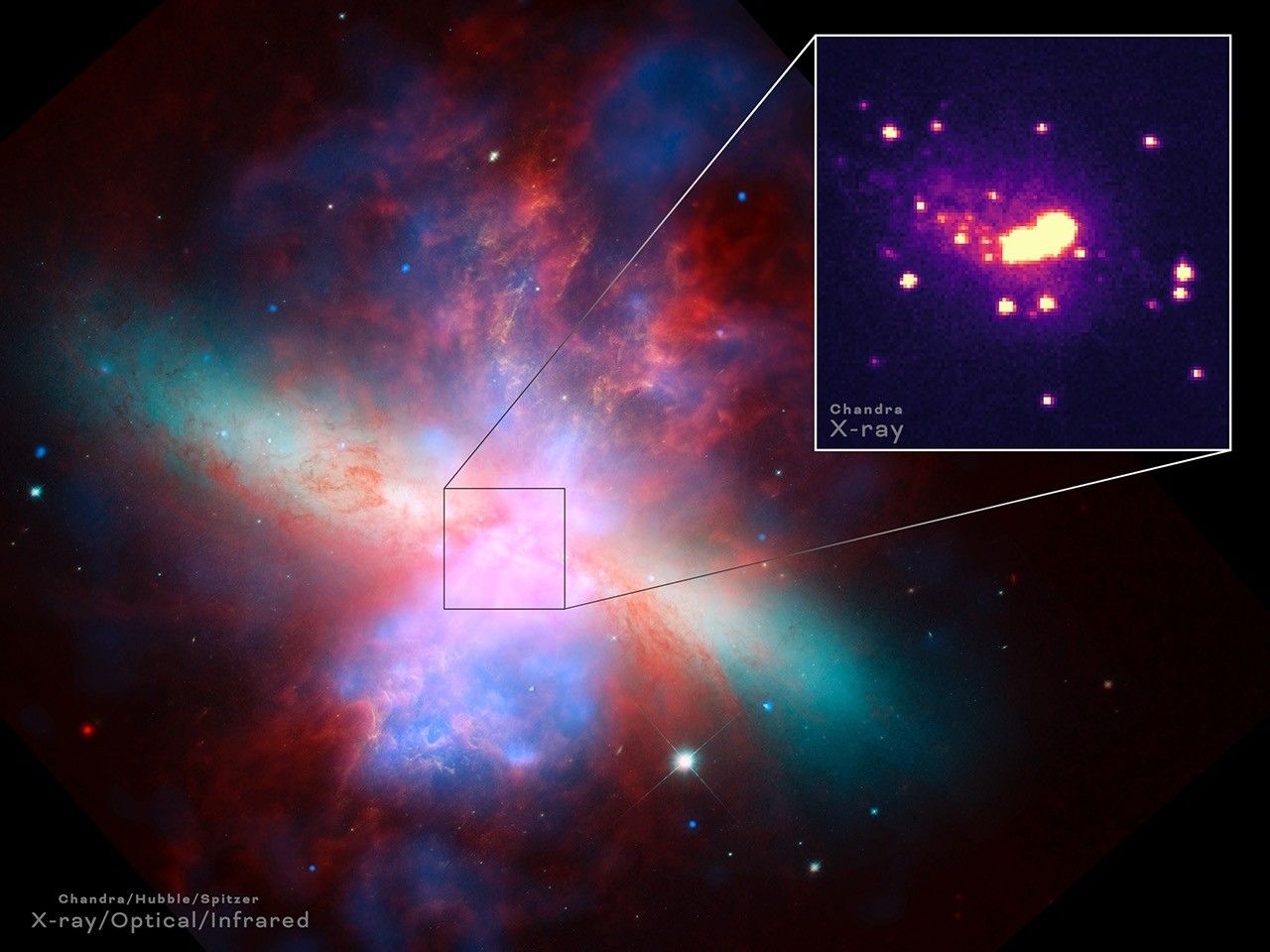
For the first time, astronomers have directly measured the speed of superheated gas billowing from a cauldron of stellar activity at the heart of M82.

An invisible companion consuming material from the naked-eye star gamma-Cas has been revealed as the culprit for curious X-rays coming from the stellar system. This closes the case on a mystery that has puzzled astronomers for more than fi…

The Cassiopeia A supernova remnant glows in X-ray, visible, and infrared light in this Jan. 8, 2024, image that combines data from NASA’s Chandra X-ray Observatory and Hubble, Webb, and Spitzer space telescopes. A study by the XRISM (X-ray…

Leading X-ray space telescopes XMM-Newton and XRISM have spotted an extraordinary blast from a supermassive black hole. In a matter of hours, the gravitational monster whipped up powerful winds, flinging material out into space at eye-wate…

Using the joint Japan Aerospace Exploration Agency (JAXA), European Space Agency (ESA), and NASA X-Ray… The post XRISM observes windy neutron star, Chandra studies a luminous quasar appeared first on NASASpaceFlight.com.
A batch of 25 satellites for the Starlink mega-constellation - SpaceX's project for space-based Internet communication system.
AST SpaceMobile’s Block 2 BlueBird satellites are designed to deliver up to 10 times the bandwidth capacity of the BlueBird Block 1 satellites, requi…
Daqi-2 (DQ-2), also known as the Atmospheric Environment Monitoring Satellite/AEMS, is the second of follow-on series of Chinese satellites to the GF…
Unknown satellite(s) for the Russian military.
A batch of 25 satellites for the Starlink mega-constellation - SpaceX's project for space-based Internet communication system.
A batch of 29 satellites for the Starlink mega-constellation - SpaceX's project for space-based Internet communication system.
8 Earth observation satellites for the Jilin-1 commercial Earth observation satellites constellation: * High Resolution-07A 02-04 * High Resoluti…
This is the 24th flight of the Orbital ATK's uncrewed resupply spacecraft Cygnus and its 23rd flight to the International Space Station under the Com…
Officially described as "Satellite-Internet Technology Demonstration Satellite". Probable 1 (?) test satellite for the Chinese state-owned LEO commun…
A batch of 25 satellites for the Starlink mega-constellation - SpaceX's project for space-based Internet communication system.


