H3 | DESTINY+ & RAMSES
To Be Determined
L - -- : -- : -- : --


DESTINY+ (Demonstration and Experiment of Space Technology for INterplanetary voYage with Phaethon fLyby and dUst Science) is a planned asteroid exploration mission to 3200 Phaethon, the parent body of the Geminids meteor shower. It will demonstrate further improvements of low cost solar electric propulsion in deep space and innovative light-weight solar array panel technology. The spacecraft will carry 3 science instruments: * DESTINY Dust Analyzer (DDA) * Telescopic Camera for Phaethon (TCAP) * Multiband Camera for Phaethon (MCAP) RAMSES (Rapid Apophis Mission for Space Safety) is a European-Japanese planetary defense mission to near-Earth asteroid 99942 Apophis, led by the European Space Agency (ESA). The spacecraft will arrive around Apophis in February 2029, before the asteroid’s very close fly-by to Earth on 13 April 2029. It will conduct measurements of the asteroid's properties before and during the Earth flyby to study its response to the close encounter with the planet. The spacecraft will leverage much of the technology developed for the Hera mission. At the asteroid, RAMSES will deploy two smaller CubeSats, one carrying a dust analyser, a low-frequency radar, the other will attempt to land on Apophis and provide high-resolution images from the surface.

Confirmation of DESTINY+ and RAMSES to be flown on the same launch vehicle.
Launch vehicle switched to H3, launch delayed to FY2028 due to delays with RTF of Epsilon rocket.
Delayed to NET FY2025.
The H3 Launch Vehicle is an expendable launch system in development in Japan. H3 rockets are liquid-propellant rockets with strap-on solid rocket boosters and are planned to be launched from the Tanegashima Space Center in Japan. Mitsubishi and the JAXA have been responsible for the design, manufacture, and operation of the H3.
See DetailsMitsubishi Heavy Industries, Ltd. is a Japanese multinational engineering, electrical equipment and electronics company headquartered in Tokyo, Japan. MHI is one of the core companies of the Mitsubishi Group. MHI's products include aerospace components, air conditioners, aircraft, automotive components, forklift trucks, hydraulic equipment, machine tools, missiles, power generation equipment, printing machines, ships and space launch vehicles. Through its defense-related activities, it is the world's 23rd-largest defense contractor measured by 2011 defense revenues and the largest based in Japan.
INFO WIKI
Los Angeles CA (SPX) Feb 13, 2026 On 10 February 2026 the European Space Agency signed a contract with OHB Italia to develop the Rapid Apophis Mission for Space Safety, known as Ramses, securing the next phase of Europes dedicated mis…
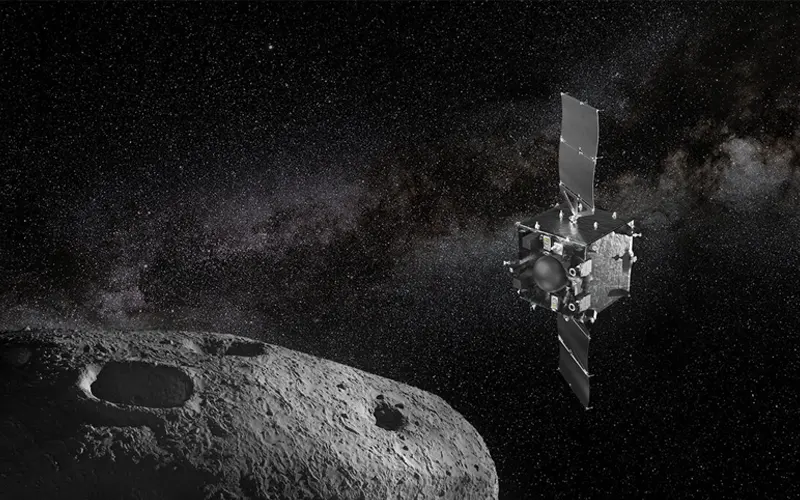
The European Space Agency (ESA) has awarded OHB Italia a €81.2 million contract for the construction, assembly, and testing phase of the agency’s Ramses mission, which will study the asteroid Apophis during its close encounter with Earth. …

On 10 February 2026, the European Space Agency (ESA) signed a contract with OHB Italia for the development of the Rapid Apophis Mission for Space Safety (Ramses). Launching in 2028, Ramses will rendezvous with the asteroid Apophis before i…
Friday the 13th of April 2029 will be our lucky day.
A batch of 25 satellites for the Starlink mega-constellation - SpaceX's project for space-based Internet communication system.
AST SpaceMobile’s Block 2 BlueBird satellites are designed to deliver up to 10 times the bandwidth capacity of the BlueBird Block 1 satellites, requi…
Daqi-2 (DQ-2), also known as the Atmospheric Environment Monitoring Satellite/AEMS, is the second of follow-on series of Chinese satellites to the GF…
Unknown satellite(s) for the Russian military.
A batch of 25 satellites for the Starlink mega-constellation - SpaceX's project for space-based Internet communication system.
A batch of 29 satellites for the Starlink mega-constellation - SpaceX's project for space-based Internet communication system.
8 Earth observation satellites for the Jilin-1 commercial Earth observation satellites constellation: * High Resolution-07A 02-04 * High Resoluti…
This is the 24th flight of the Orbital ATK's uncrewed resupply spacecraft Cygnus and its 23rd flight to the International Space Station under the Com…
Officially described as "Satellite-Internet Technology Demonstration Satellite". Probable 1 (?) test satellite for the Chinese state-owned LEO commun…
A batch of 25 satellites for the Starlink mega-constellation - SpaceX's project for space-based Internet communication system.