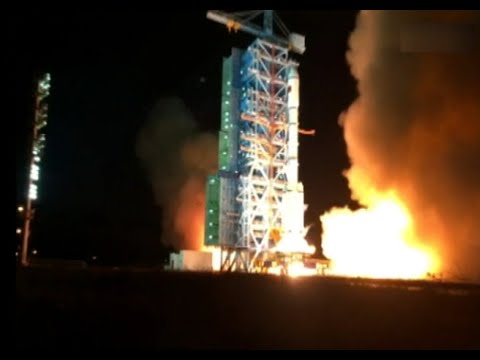
Long March 2F/G | Tiangong-2
Launch Successful
L - -- : -- : -- : --
Launch Window
Sept. 15, 2016, 2:04 p.m. - Sept. 15, 2016, 2:19 p.m.


Sept. 15, 2016, 2:04 p.m. - Sept. 15, 2016, 2:19 p.m.
China's second space station, Tiangong-2 is tasked to verify key technologies such as cargo transportation, on-orbit propellant resupply, and a medium-term stay of astronauts. It will also carry an array of scientific experiments, and will be equipped with a robotic arm to help the assembly and maintenance of the station.
The Long March 2F is a Chinese orbital carrier rocket, part of the Long March 2 rocket family. Designed to launch the crewed Shenzhou spacecraft, the Long March 2F is a human-rated two-stage version of the Long March 2E rocket, which in turn was based on the Long March 2C launch vehicle. It is launched from complex SLS at the Jiuquan Satellite Launch Center. The Long March 2F/G version includes longer boosters for increased lift capability, among other improvements.
The China Aerospace Science and Technology Corporation (CASC) is the main contractor for the Chinese space program. It is state-owned and has a number of subordinate entities which design, develop and manufacture a range of spacecraft, launch vehicles, strategic and tactical missile systems, and ground equipment. It was officially established in July 1999 as part of a Chinese government reform drive, having previously been one part of the former China Aerospace Corporation. Various incarnations of the program date back to 1956.
INFO WIKI

A batch of 29 satellites for the Starlink mega-constellation - SpaceX's project for space-based Internet communication system.
A batch of 25 satellites for the Starlink mega-constellation - SpaceX's project for space-based Internet communication system.
A pair of Chinese satellites reported to be for "Earth observation technological testing and validation" purposes. Actual usage not known.
A batch of 9 Low Earth Orbit communication satellites for the Chinese state owned SatNet constellation operated by the China Satellite Network Group.…
Firefly Alpha's Flight 7 is a test flight and return-To-Flight for the launch vehicle after its April 2025 launch failure. It will test and validate …
EchoStar 25 is a direct broadcast satellite, built on the proven Maxar 1300 series platform, which will deliver content across North America. It will…
A batch of 25 satellites for the Starlink mega-constellation - SpaceX's project for space-based Internet communication system.
Note: Payload and customer identities were not publicly announced. 4th of the BlackSky Gen-3 high resolution Earth-imaging satellites.
Third flight of the KAIROS launch vehicle. 5 satellites will be on board: * TATARA-1R * SC-Sat1a * HErO * AETS-1 * Nutsat-3 (TASA/Taiwan)
A batch of 29 satellites for the Starlink mega-constellation - SpaceX's project for space-based Internet communication system.