Long March 3B | ChinaSat 9B
Launch Successful
L - -- : -- : -- : --
Launch Window
Sept. 9, 2021, 11:39 a.m. - Sept. 9, 2021, 12:09 p.m.


Sept. 9, 2021, 11:39 a.m. - Sept. 9, 2021, 12:09 p.m.
Zhongxing-9B (ChinaSat 9B) is a Chinese communications satellite, that will replace the Zhongxing-9A satellite in orbit. The latter was launched in 2017, but the CZ-3B launch vehicle suffered a partial failure, and the satellite had to burn a large amount of fuel to reach its nominal orbit. ZX-9B will be used to retransmit television to the Chinese, as well as to provide television communications with Chinese islands, and ships sailing near the coast. The satellite will also be used to broadcast the 2022 Beijing Winter Olympics in 8K.

Launch success.
Added launch per NOTAMs.
The Long March 3B / E (G2) (CZ-3B / E) is one of the most successful medium-range launchers and the strongest variant of the CZ-3 series. It was specially developed for the transport of heavy communications satellites into a geostationary transfer orbit. The additional designation "E" stands for a higher payload fairing, stretched boosters and extended fuel tanks at the first stage, over the CZ-3B.
The China Aerospace Science and Technology Corporation (CASC) is the main contractor for the Chinese space program. It is state-owned and has a number of subordinate entities which design, develop and manufacture a range of spacecraft, launch vehicles, strategic and tactical missile systems, and ground equipment. It was officially established in July 1999 as part of a Chinese government reform drive, having previously been one part of the former China Aerospace Corporation. Various incarnations of the program date back to 1956.
INFO WIKI
A replacement Chinese communications satellite for a craft launched into the wrong orbit four years ago successfully rocketed into space Thursday, just in time to be ready to support 4K and 8K television broadcasts of the Beijing Winter Ol…
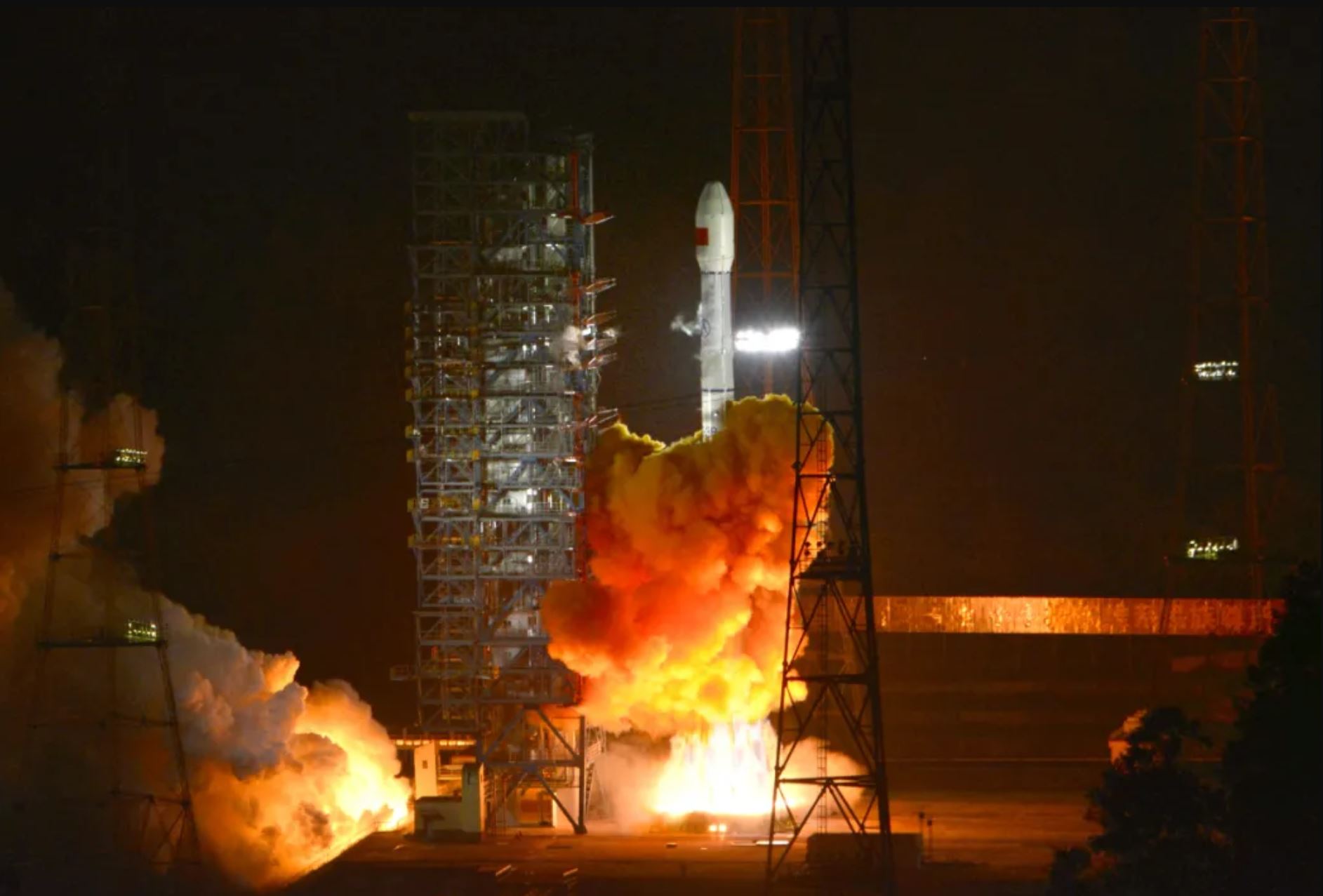
China conducted its 33rd launch of 2021 early Thursday, successfully sending the ChinaSat-9B communications satellite into geosynchronous transfer orbit.

Thursday marked another successful mission in China’s busy 2021 launch manifest, this time lofting the Zhongxing-9B (ChinaSat-9B) into orbit on a Long March 3B from the Xichang Satellite Launch Center. This satellite serves as a replacemen…
Amazon Leo, formerly known as Project Kuiper, is a mega constellation of satellites in Low Earth Orbit that will offer broadband internet access, thi…
Note: Payload identity uncertain. Meridian is a series of communications satellite for military and civilian use.
First test launch of Space Pioneer’s Tianlong-3 rocket.
A batch of 29 satellites for the Starlink mega-constellation - SpaceX's project for space-based Internet communication system.
Artemis II is the first crewed mission as part of the Artemis program. Artemis II will send a crew of 4 - 3 Americans and 1 Canadian around the moon …
A batch of 29 satellites for the Starlink mega-constellation - SpaceX's project for space-based Internet communication system.
Dedicated rideshare flight to a sun-synchronous orbit with dozens of small microsatellites and nanosatellites for commercial and government customers.
First test launch and mission of CAS Space’s Kinetica-2 rocket, with 3 spacecraft on board: * New March 02 (Qingzhou space station cargo resupply …
The European Space Agency (ESA)'s LEO-PNT (Low Earth Orbit Positioning, Navigation and Timing) demonstrator mission will feature a 10-satellite const…
Chinese satellite reported to be for "space environment research" purposes. Actual usage not known.