Nuri | Flight Test 2
Launch Successful
L - -- : -- : -- : --
Launch Window
June 21, 2022, 6 a.m. - June 21, 2022, 8 a.m.


June 21, 2022, 6 a.m. - June 21, 2022, 8 a.m.
Second flight of the KSLV-II "Nuri" launch vehicle, carrying a dummy satellite Payload of 1500 kg to sun-synchronous orbit. The mission will in addition launch the performance verification satellite (PVSAT) and four Cubesats: - CubeSat (6U) STEP Cube Lab-II - CubeSat (3U) SNUGLITE-II - CubeSat (3U) MIMAN - CubeSat (3U) RANDEV

Successful launch confirmed.
Liftoff
English webcast live

Rescheduled for June 21
Scrubbed due to LOX tank sensor problem; requires roll-back
Nuri, also known as KSLV-II, is South Korea's second carrier rocket and the successor to KSLV-1.
See DetailsThe Korea Aerospace Research Institute (KARI) established in 1989, is the aeronautics and space agency of Republic of Korea. Its main laboratories are located in Daejeon, in the Daedeok Science Town.
INFO WIKI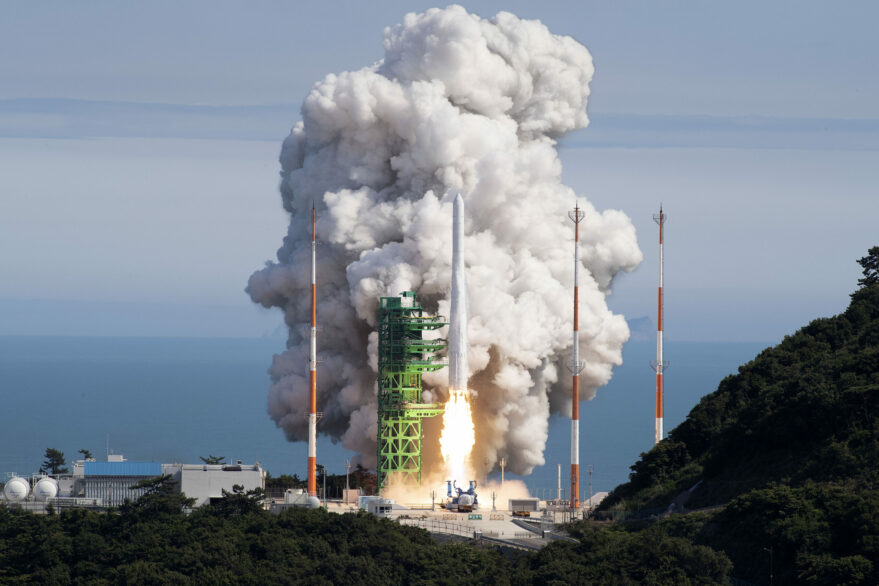
South Korea’s homegrown rocket KSLV-2 successfully put satellites into low Earth orbit for the first time in its second flight June 21.

The Korean Aerospace Research Institute (KARI) has conducted its second launch of the Korea Space Launch Vehicle (KSLV)-II rocket, also known as Nuri. This was Nuri’s return to flight after nearly reaching orbit on its previous mission. Th…
Daqi-2 (DQ-2), also known as the Atmospheric Environment Monitoring Satellite/AEMS, is the second of follow-on series of Chinese satellites to the GF…
Unknown satellite(s) for the Russian military.
A batch of 25 satellites for the Starlink mega-constellation - SpaceX's project for space-based Internet communication system.
A batch of 29 satellites for the Starlink mega-constellation - SpaceX's project for space-based Internet communication system.
8 Earth observation satellites for the Jilin-1 commercial Earth observation satellites constellation: * High Resolution-07A 02-04 * High Resoluti…
This is the 24th flight of the Orbital ATK's uncrewed resupply spacecraft Cygnus and its 23rd flight to the International Space Station under the Com…
Officially described as "Satellite-Internet Technology Demonstration Satellite". Probable 1 (?) test satellite for the Chinese state-owned LEO commun…
A batch of 25 satellites for the Starlink mega-constellation - SpaceX's project for space-based Internet communication system.
A batch of 5 Low Earth Orbit communication satellites for the Chinese state owned SatNet constellation operated by the China Satellite Network Group.…
18 Low Earth Orbit communication satellites with Ku, Q and V band payloads for the G60 constellation operated by Shanghai Spacesail Technologies with…