PSLV-XL | Proba-3
Launch Successful
L - -- : -- : -- : --
Instantaneous launch window.
Launch Window
Dec. 5, 2024, 10:34 a.m. - Dec. 5, 2024, 10:34 a.m.


Instantaneous launch window.
Dec. 5, 2024, 10:34 a.m. - Dec. 5, 2024, 10:34 a.m.
Proba-3 (Project for On-Board Autonomy 3) is the first close formation flying mission for the European Space Agency (ESA). It consists of two independent, three-axis stabilised spacecraft flying 150 meters from one another with the ability to accurately control the attitude and separation of the two craft. Such formation flying will be maintained for 6 hours, creating ″artificial solar eclipse″ for the satellite below. The spacecraft pair will fly a highly elliptical orbit divided between periods of accurate formation flying around apogee, when payload operations will be possible, and periods of free flight.

Spacecrafts now in contact.
Spacecraft separation.
Liftoff.

Official Webcast by ISRO Official has started
Tweaked new launch time.
PSLV-XL is the upgraded version of Polar Satellite Launch Vehicle in its standard configuration boosted by more powerful, stretched strap-on boosters with 12 tonne propellant load. Weighing 320t at lift-off, the vehicle uses larger strap-on motors (PSOM-XL or S12) to achieve higher payload capability. On 29 December 2005, ISRO successfully tested the improved version of strap-on booster for the PSLV. The first use of PSLV-XL was the launch of Chandrayaan-1 by PSLV C11. The payload capability for this variant is 1,800 kg to SSO.
The Indian Space Research Organisation (ISRO) is the space agency of the Government of India headquartered in the city of Bangalore. Its vision is to "harness space technology for national development while pursuing space science research and planetary exploration."
INFO WIKI
The European Space Agency has regained contact with the Coronagraph spacecraft of its Proba-3 mission after more than a month of silence. Launched aboard an ISRO PSLV-XL rocket in December 2024, the Proba-3 mission’s Coronagraph and Occult…

A month after an anomaly onboard the Proba-3 mission caused ground control to lose contact with the Coronagraph spacecraft, the mission team shares great news: the spacecraft has phoned home, re-establishing the lost connection.
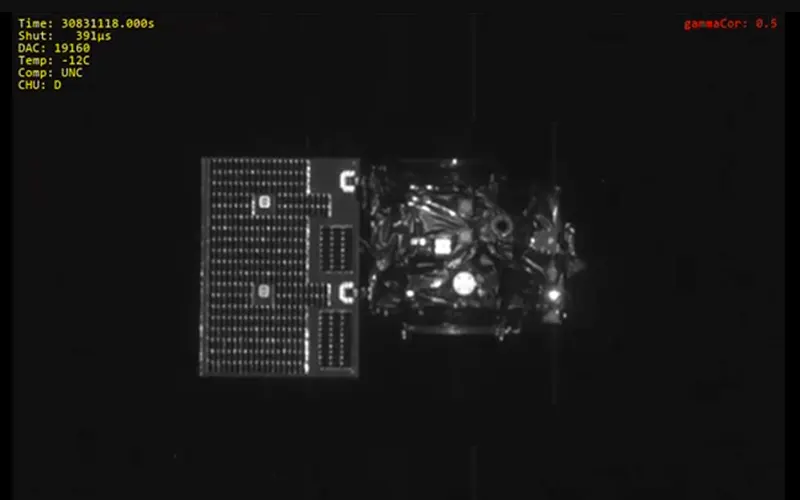
The European Space Agency announced on 6 March that it had lost contact with one of the two spacecraft that make up its PROBA-3 mission. Both PROBA-3 spacecraft were launched aboard an ISRO PSLV-XL rocket in December 2024. The mission’s Co…

An anomaly onboard the Proba-3 mission’s Coronagraph spacecraft led to loss of contact between the spacecraft and ground control. The root cause of the anomaly is under investigation and mission teams are working hard to recover the situat…

18 Low Earth Orbit communication satellites with Ku, Q and V band payloads for the G60 constellation operated by Shanghai Spacesail Technologies with…
STP-S29A is a mission under the U.S. Department of Defense's Space Test Program (STP) that will deliver technology demonstrations to orbit and contri…
A batch of 25 satellites for the Starlink mega-constellation - SpaceX's project for space-based Internet communication system.
Amazon Leo, formerly known as Project Kuiper, is a mega constellation of satellites in Low Earth Orbit that will offer broadband internet access, thi…
Note: Payload identity uncertain. Meridian is a series of communications satellite for military and civilian use.
First test launch of Space Pioneer’s Tianlong-3 rocket.
A batch of 29 satellites for the Starlink mega-constellation - SpaceX's project for space-based Internet communication system.
Artemis II is the first crewed mission as part of the Artemis program. Artemis II will send a crew of 4 - 3 Americans and 1 Canadian around the moon …
A batch of 29 satellites for the Starlink mega-constellation - SpaceX's project for space-based Internet communication system.
Dedicated rideshare flight to a sun-synchronous orbit with dozens of small microsatellites and nanosatellites for commercial and government customers.