Soyuz 2.1a | Soyuz MS-18
Launch Successful
L - -- : -- : -- : --
Instantaneous launch window.
Launch Window
April 9, 2021, 7:42 a.m. - April 9, 2021, 7:42 a.m.


Instantaneous launch window.
April 9, 2021, 7:42 a.m. - April 9, 2021, 7:42 a.m.
Soyuz MS-18 begins expedition 65 by carrying Roscosmos cosmonauts Oleg Novitsky, Pyotr Dubrov and NASA astronaut Mark Vande Hei to the International Space Station aboard the Soyuz spacecraft from the Baikonur Cosmodrome in Kazakhstan. After launching from the Baikonur Cosmodrome in Kazakhstan, they will rendezvous to the station where they will remain for their 6 month stay.

Successful launch of Soyuz MS-18 towards the International Space Station. Docking scheduled at 11:07 UTC.
Launch scheduled for April 9 07:42 UTC
The Soyuz 2.1A converted the flight control system from analog to digital, which allowed launch from fixed platforms. It also allowed big fairings and payloads. It is currently used for crewed Soyuz and Progress flights to the ISS.
Launched to the ISS in April 2021.
Soyuz MS Details
Date of
Birth: Oct. 12, 1971
Age: 54
Date of
Birth: Jan. 30, 1978
Age: 48
Date of
Birth: Nov. 10, 1966
Age: 59
Progress Rocket Space Centre, formerly known as TsSKB-Progress, is a space science and aerospace research company which is known for manufacturing launch vehicles and satellites. Most notably, Progress Rocket Space Centre is the manufacturer of Soyuz launch vehicles.
INFO WIKI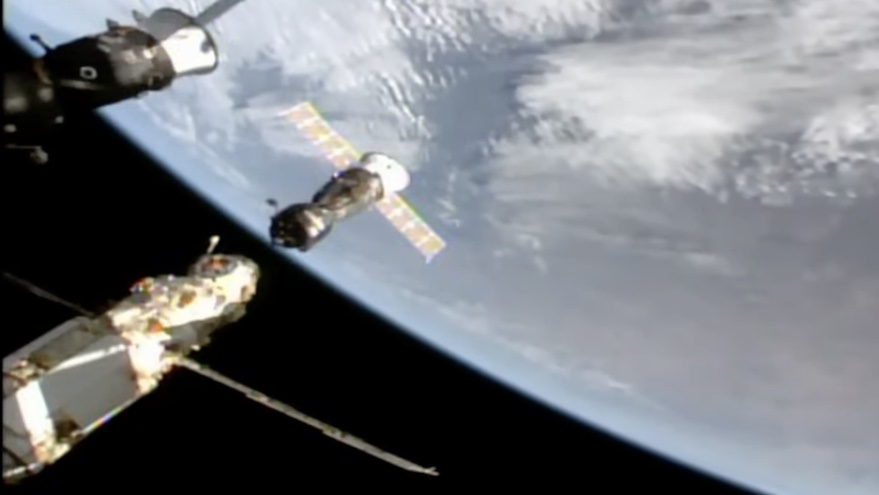

STORY WRITTEN FOR CBS NEWS & USED WITH PERMISSION A Russian actress and her director-cameraman, wrapping up a 12-day movie shoot aboard the International Space Station, returned to Earth Sunday and promptly filmed a few additional scenes t…


Two Russian cosmonauts and a NASA astronaut strapped into their Soyuz ferry ship Tuesday at the International Space Station, ready to move the craft to a new docking port on Russia’s Nauka lab module that arrived at the complex in July.

The Soyuz MS-18 crew has successfully relocated their spacecraft from the Rassvet module to the Nauka module at the International Space Station.
Amazon Leo, formerly known as Project Kuiper, is a mega constellation of satellites in Low Earth Orbit that will offer broadband internet access, thi…
Note: Payload identity uncertain. Meridian is a series of communications satellite for military and civilian use.
First test launch of Space Pioneer’s Tianlong-3 rocket.
A batch of 29 satellites for the Starlink mega-constellation - SpaceX's project for space-based Internet communication system.
Artemis II is the first crewed mission as part of the Artemis program. Artemis II will send a crew of 4 - 3 Americans and 1 Canadian around the moon …
A batch of 29 satellites for the Starlink mega-constellation - SpaceX's project for space-based Internet communication system.
Dedicated rideshare flight to a sun-synchronous orbit with dozens of small microsatellites and nanosatellites for commercial and government customers.
First test launch and mission of CAS Space’s Kinetica-2 rocket, with 3 spacecraft on board: * New March 02 (Qingzhou space station cargo resupply …
The European Space Agency (ESA)'s LEO-PNT (Low Earth Orbit Positioning, Navigation and Timing) demonstrator mission will feature a 10-satellite const…
Chinese satellite reported to be for "space environment research" purposes. Actual usage not known.

