Soyuz 2.1a | Soyuz MS-23
Launch Successful
L - -- : -- : -- : --
Instantaneous launch window.
Launch Window
Feb. 24, 2023, 12:24 a.m. - Feb. 24, 2023, 12:24 a.m.


Instantaneous launch window.
Feb. 24, 2023, 12:24 a.m. - Feb. 24, 2023, 12:24 a.m.
Soyuz MS-23 will fly without crew to the International Space Station from the Baikonur Cosmodrome in Kazakhstan to replace Soyuz MS-22, that suffered a thermal control system depressurization/leak on the ISS on December 15, 2022.

Successful launch of Soyuz MS-23 into the rendezvous trajectory
Liftoff
Coverage live

Updated T-0.

Adding new launch time
The Soyuz 2.1A converted the flight control system from analog to digital, which allowed launch from fixed platforms. It also allowed big fairings and payloads. It is currently used for crewed Soyuz and Progress flights to the ISS.
Scheduled to launch to the ISS in early 2023.
Soyuz MS DetailsProgress Rocket Space Centre, formerly known as TsSKB-Progress, is a space science and aerospace research company which is known for manufacturing launch vehicles and satellites. Most notably, Progress Rocket Space Centre is the manufacturer of Soyuz launch vehicles.
INFO WIKI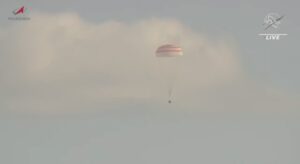
A Soyuz capsule landed in Kazakhstan Sept. 27, returning two Russians and one American from the International Space Station after more than a year in orbit.

NASA astronaut Frank Rubio and two Russian colleagues landed in Kazakhstan this morning after 371 days in space, a new record for a U.S. astronaut. The duration was a surprise. […]

During his record-breaking mission, Rubio spent many hours on scientific activities aboard the space station, conducting a variety of tasks ranging from plant research to physical sciences studies.

Now the record-holder for the longest single spaceflight by an American, NASA astronaut Frank Rubio is scheduled to depart the International Space Station and return to Earth Wednesday, Sept. 27. The agency will provide full coverage from …

Today Frank Rubio becomes the first U.S. astronaut to spend one year in space. Others have come close, but the 365-day mark has been met by only four other humans […]
A batch of 25 satellites for the Starlink mega-constellation - SpaceX's project for space-based Internet communication system.
Amazon Leo, formerly known as Project Kuiper, is a mega constellation of satellites in Low Earth Orbit that will offer broadband internet access, thi…
Note: Payload identity uncertain. Meridian is a series of communications satellite for military and civilian use.
First test launch of Space Pioneer’s Tianlong-3 rocket.
A batch of 29 satellites for the Starlink mega-constellation - SpaceX's project for space-based Internet communication system.
Artemis II is the first crewed mission as part of the Artemis program. Artemis II will send a crew of 4 - 3 Americans and 1 Canadian around the moon …
A batch of 29 satellites for the Starlink mega-constellation - SpaceX's project for space-based Internet communication system.
Dedicated rideshare flight to a sun-synchronous orbit with dozens of small microsatellites and nanosatellites for commercial and government customers.
First test launch and mission of CAS Space’s Kinetica-2 rocket, with 3 spacecraft on board: * New March 02 (Qingzhou space station cargo resupply …
The European Space Agency (ESA)'s LEO-PNT (Low Earth Orbit Positioning, Navigation and Timing) demonstrator mission will feature a 10-satellite const…