Soyuz STA/Fregat | Falcon Eye 2
Launch Successful
L - -- : -- : -- : --
Instantaneous launch window.
Launch Window
Dec. 2, 2020, 1:33 a.m. - Dec. 2, 2020, 1:33 a.m.


Instantaneous launch window.
Dec. 2, 2020, 1:33 a.m. - Dec. 2, 2020, 1:33 a.m.

For its eighth launch of the year and the third Soyuz flight of 2020, Arianespace will orbit the FalconEye satellite. FalconEye is a high performance optical Earth observation satellite system for the Armed Forces of the United Arab Emirates (UAEAF) manufactured by the consortium of Airbus Defence ...
On November 29, Arianespace will carry out from the Guiana Space Center (CSG) in French Guiana, its eighth launch of the year. This mission will be the third realized this year with the Soyuz medium-lift launch vehicle, the two previous ones were conducted from Russia. The launcher will be carryin...
Falcon Eye 2 is a high-resolution Earth-imaging satellite for the United Arab Emirates. Built by Airbus Defense and Space with an optical imaging payload from Thales Alenia Space, Falcon Eye is the second of two surveillance satellites ordered by the UAE's military.

Added webcast link.
Updated exact T-0, added mission page url

go per CNES
Soyuz/Falcon Eye 2 should be Nov. 28 in Kourou/29 UTC per SFN
The 2.1a version includes conversion from analog to digital flight control system and uprated engines on the booster and the first stage with improved injection systems. The new digital flight control and telemetry systems allow the rocket to launch from a fixed rather than angled launch platform and adjust its heading in flight. A digital control system also enables the launch of larger commercial satellites with wider and longer payload fairings such as the ST-type fairing. These fairings introduce too much aerodynamic instability for the old analog system to handle. This stage continues to use the RD-0110 engine. The 2.1a/ST version is sometimes called Soyuz ST-A.
Progress Rocket Space Centre, formerly known as TsSKB-Progress, is a space science and aerospace research company which is known for manufacturing launch vehicles and satellites. Most notably, Progress Rocket Space Centre is the manufacturer of Soyuz launch vehicles.
INFO WIKI
After months of delays caused by launch vehicle issues and the coronavirus pandemic, a Russian Soyuz rocket and Fregat upper stage took off from South America and delivered the French-built Falcon Eye 2 military observation satellite to an…
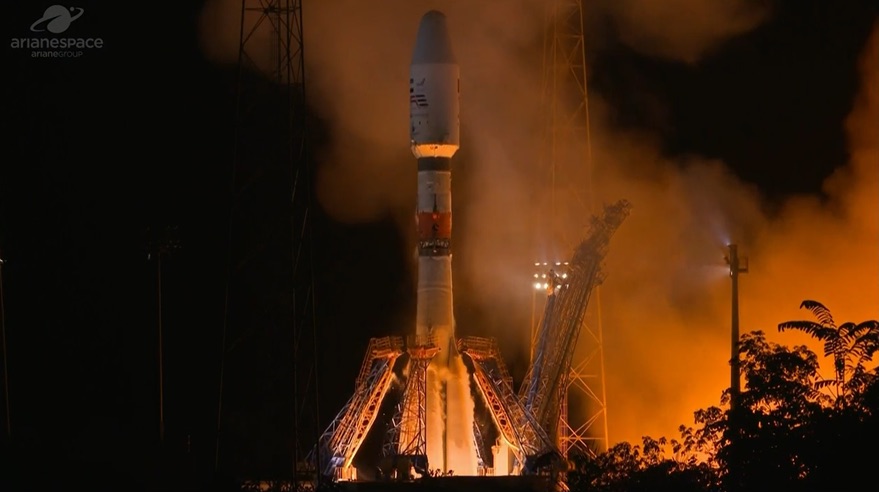
An Arianespace Soyuz rocket successfully launched a reconnaissance satellite for the United Arab Emirates Dec. 1 after months of delays caused by technical problems and the pandemic.

Arianespace has used — with Russia’s support — a Soyuz ST-A rocket to launch a joint military and civilian Earth imaging satellite for the United Arab Emirates Armed Forces from the Guiana Space Centre near Kourou, French Guiana.

A Soyuz booster is set for launch from French Guiana Sunday night with a European-built military reconnaissance satellite for the United Arab Emirates, the twin of a UAE surveillance craft lost in a rocket failure last year.
Arianespace was to use — with Russia’s support — a Soyuz ST-A rocket to launch a joint military and civilian Earth imaging satellite for the United Arab Emirates Armed Forces from the Guiana Space Centre near Kourou, French Guiana.
A batch of 25 satellites for the Starlink mega-constellation - SpaceX's project for space-based Internet communication system.
Amazon Leo, formerly known as Project Kuiper, is a mega constellation of satellites in Low Earth Orbit that will offer broadband internet access, thi…
Note: Payload identity uncertain. Meridian is a series of communications satellite for military and civilian use.
First test launch of Space Pioneer’s Tianlong-3 rocket.
A batch of 29 satellites for the Starlink mega-constellation - SpaceX's project for space-based Internet communication system.
Artemis II is the first crewed mission as part of the Artemis program. Artemis II will send a crew of 4 - 3 Americans and 1 Canadian around the moon …
A batch of 29 satellites for the Starlink mega-constellation - SpaceX's project for space-based Internet communication system.
Dedicated rideshare flight to a sun-synchronous orbit with dozens of small microsatellites and nanosatellites for commercial and government customers.
First test launch and mission of CAS Space’s Kinetica-2 rocket, with 3 spacecraft on board: * New March 02 (Qingzhou space station cargo resupply …
The European Space Agency (ESA)'s LEO-PNT (Low Earth Orbit Positioning, Navigation and Timing) demonstrator mission will feature a 10-satellite const…