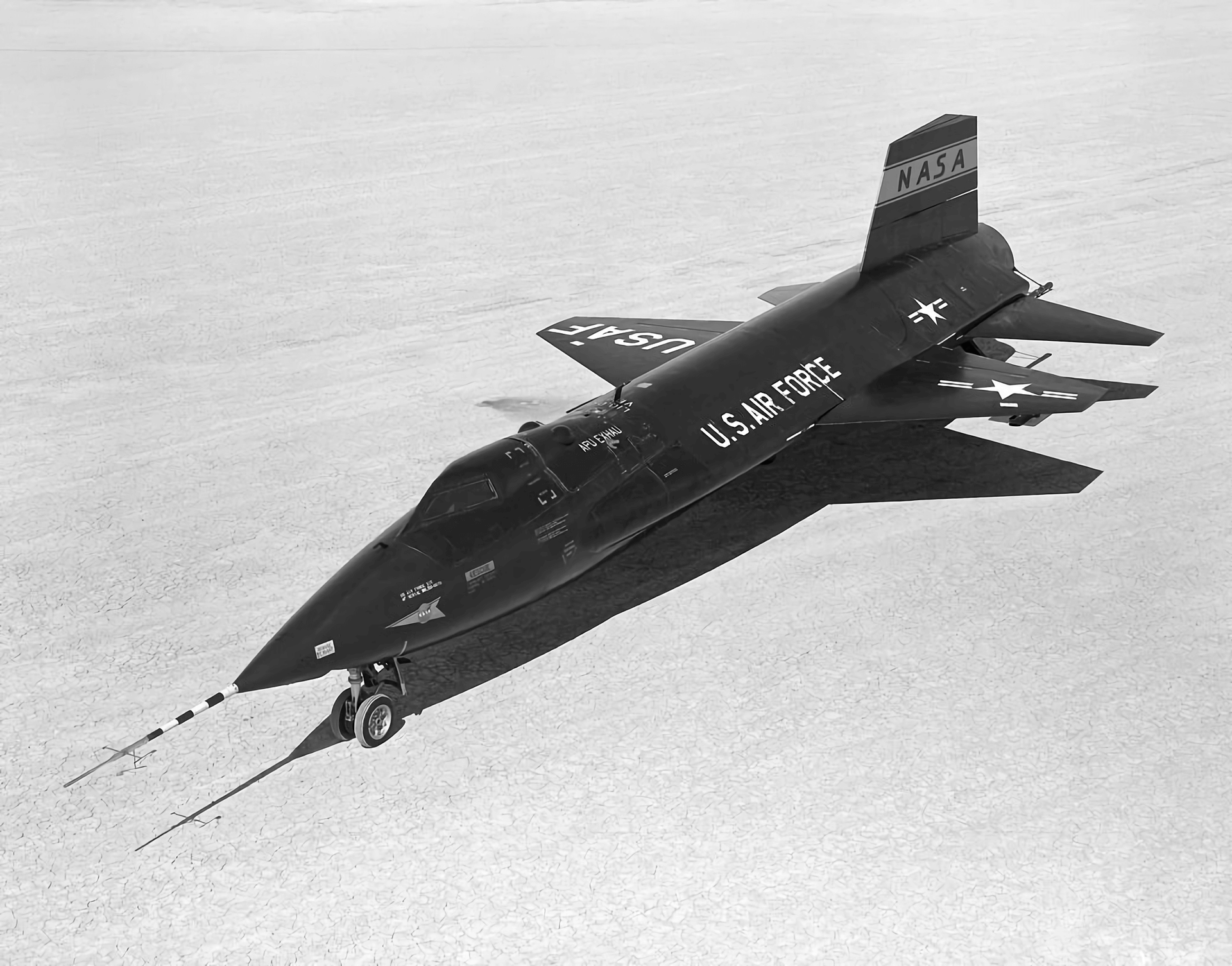
North American X-15
In-active Re-UsableNorth American Aviation ()
June 8, 1959
Description
The North American X-15 was a hypersonic rocket-powered aircraft operated by the United States Air Force and the National Aeronautics and Space Administration as part of the X-plane series of experimental aircraft.
Specifications
-
Stages
1 -
Length
15.47 m -
Diameter
6.61 m -
Fairing Diameter
― -
Launch Mass
15195.0 T -
Thrust
286.0 kN -
Apogee (Sub-Orbital)
108.0 km
Family
-
Name
North American X-15 -
Family
― -
Variant
― -
Alias
― -
Full Name
North American X-15
Payload Capacity
-
Launch Cost
― -
Low Earth Orbit
― -
Geostationary Transfer
Orbit
― -
Direct Geostationary
― -
Sun-Synchronous Capacity
―
North American Aviation
Commercial
None
1928North American Aviation (NAA) was a major American aerospace manufacturer, responsible for a number of historic aircraft, including the T-6 Texan trainer, the P-51 Mustang fighter, the B-25 Mitchell bomber, the F-86 Sabre jet fighter, the X-15 rocket plane, and the XB-70, as well as Apollo command and service module, the second stage of the Saturn V rocket, the Space Shuttle orbiter and the B-1 Lancer.
X-15 | Flight 197
North American Aviation | United States of AmericaAir launch to Suborbital flight
Aug. 21, 1968, 5:05 p.m.
X-15 | Flight 191
North American Aviation | United States of AmericaAir launch to Suborbital flight
Nov. 15, 1967, 6:30 p.m.
X-15 | Flight 190
North American Aviation | United States of AmericaAir launch to Suborbital flight
Oct. 17, 1967, 5:40 p.m.
X-15 | Flight 174
North American Aviation | United States of AmericaAir launch to Suborbital flight
Nov. 1, 1966, 9:24 p.m.
X-15 | Flight 153
North American Aviation | United States of AmericaAir launch to Suborbital flight
Oct. 14, 1965, 8:47 p.m.
X-15 | Flight 150
North American Aviation | United States of AmericaAir launch to Suborbital flight
Sept. 28, 1965, 6:08 p.m.
X-15 | Flight 143
North American Aviation | United States of AmericaAir launch to Suborbital flight
Aug. 10, 1965, 7:24 p.m.
X-15 | Flight 138
North American Aviation | United States of AmericaAir launch to Suborbital flight
June 29, 1965, 6:21 p.m.
X-15 | Flight 91
North American Aviation | United States of AmericaAir launch to Suborbital flight
Aug. 22, 1963, 6:05 p.m.
X-15 | Flight 90
North American Aviation | United States of AmericaAir launch to Suborbital flight
July 19, 1963, 6:20 p.m.
X-15 | Flight 87
North American Aviation | United States of AmericaAir launch to Suborbital flight
June 27, 1963, 5:56 p.m.
X-15 | Flight 77
North American Aviation | United States of AmericaAir launch to Suborbital flight
Jan. 17, 1963, 4:59 p.m.
X-15 | Flight 62
North American Aviation | United States of AmericaAir launch to Suborbital flight
July 17, 1962, 5:30 p.m.
Falcon 9
Starlink Group 10-41
Space Launch Complex 40 - Cape Canaveral SFS, FL, USAA batch of 29 satellites for the Starlink mega-constellation - SpaceX's project for space-based Internet communication system.
Falcon 9
Starlink Group 17-23
Space Launch Complex 4E - Vandenberg SFB, CA, USAA batch of 25 satellites for the Starlink mega-constellation - SpaceX's project for space-based Internet communication system.
Electron
That's Not A Knife (DART AE)
Rocket Lab Launch Complex 2 (Launch Area 0 C) - Wallops Flight Facility, Virginia, USAPayload is a scramjet-powered hypersonic vehicle developed by by Australian company Hypersonix.
Falcon 9
Starlink Group 6-108
Space Launch Complex 40 - Cape Canaveral SFS, FL, USAA batch of 29 satellites for the Starlink mega-constellation - SpaceX's project for space-based Internet communication system.
Falcon 9
Starlink Group 17-26
Space Launch Complex 4E - Vandenberg SFB, CA, USAA batch of 25 satellites for the Starlink mega-constellation - SpaceX's project for space-based Internet communication system.

