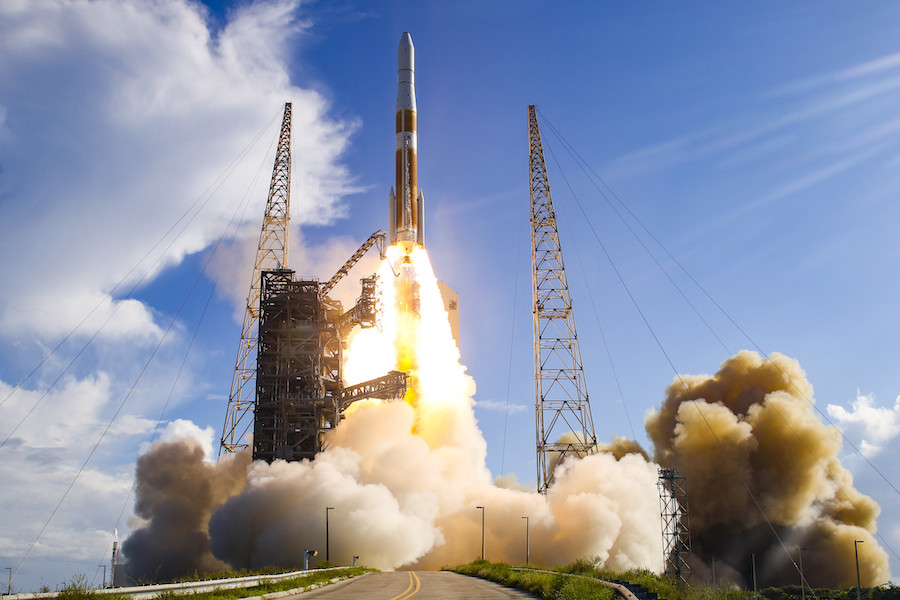
Delta IV M+(4,2)
In-activeUnited Launch Alliance (ULA)
Nov. 20, 2002
Description
Specifications
-
Stages
2 -
Length
66.2 m -
Diameter
5.0 m -
Fairing Diameter
― -
Launch Mass
292.0 T -
Thrust
4200.0 kN -
Apogee (Sub-Orbital)
40000.0 km
Family
-
Name
Delta IV M+(4,2) -
Family
― -
Variant
M+(4,2) -
Alias
― -
Full Name
Delta IV M+(4,2)
Payload Capacity
-
Launch Cost
$350000000 -
Low Earth Orbit
11920.0 kg -
Geostationary Transfer
Orbit
6270.0 kg -
Direct Geostationary
― -
Sun-Synchronous Capacity
―
United Launch Alliance
Commercial
Interim CEO: John Elbon
ULA 2006United Launch Alliance (ULA) is a joint venture of Lockheed Martin Space Systems and Boeing Defense, Space & Security. ULA was formed in December 2006 by combining the teams at these companies which provide spacecraft launch services to the government of the United States. ULA launches from both coasts of the US. They launch their Atlas V vehicle from LC-41 in Cape Canaveral and LC-3E at Vandeberg. Their Delta IV launches from LC-37 at Cape Canaveral and LC-6 at Vandenberg.
Delta IV M+(4,2) | GPS III SV02
United Launch Alliance | United States of AmericaCape Canaveral SFS, FL, USA
Aug. 22, 2019, 1:06 p.m.
Delta IV M+(4,2) | AFSPC-6
United Launch Alliance | United States of AmericaCape Canaveral SFS, FL, USA
Aug. 19, 2016, 4:52 a.m.
Delta IV M+(4,2) | GPS IIF-9 (USA-260)
United Launch Alliance | United States of AmericaCape Canaveral SFS, FL, USA
March 25, 2015, 6:36 p.m.
Delta IV M+(4,2) | AFSPC-4
United Launch Alliance | United States of AmericaCape Canaveral SFS, FL, USA
July 28, 2014, 11:28 p.m.
Delta IV M+(4,2) | GPS IIF-6 (USA-251)
United Launch Alliance | United States of AmericaCape Canaveral SFS, FL, USA
May 17, 2014, 12:03 a.m.
Status: Launch Successful
Mission:
GPS IIF (Global Positioning System) or Navstar-2F (Navigation System using Timing And Ranging) satellites are the fourth evolution stage of the second generation of the GPS satellites. Improvements included an extended design life of 12 years, faster processors with more memory, and a new civil signal on a third frequency.
Medium Earth OrbitDelta IV M+(4,2) | GPS IIF-5 (USA-248)
United Launch Alliance | United States of AmericaCape Canaveral SFS, FL, USA
Feb. 21, 2014, 1:59 a.m.
Status: Launch Successful
Mission:
GPS Block IIF, or GPS IIF is an interim class of GPS satellite, which will be used to keep the Navstar Global Positioning System operational until the GPS Block IIIA satellites become operational. They are being built by Boeing, and will be operated by the United States Air Force following their launch by United Launch Alliance, using Evolved Expendable Launch Vehicles.
Medium Earth OrbitDelta IV M+(4,2) | GPS IIF-3 (USA-239)
United Launch Alliance | United States of AmericaCape Canaveral SFS, FL, USA
Oct. 4, 2012, 12:10 p.m.
Delta IV M+(4,2) | GPS IIF-2 (USA-232)
United Launch Alliance | United States of AmericaCape Canaveral SFS, FL, USA
July 16, 2011, 6:41 a.m.
Delta IV M+(4,2) | NROL-27 (SDS) (USA-227)
United Launch Alliance | United States of AmericaCape Canaveral SFS, FL, USA
March 11, 2011, 11:38 p.m.
Delta IV M+(4,2) | GPS IIF SV-1 (USA-213)
United Launch Alliance | United States of AmericaCape Canaveral SFS, FL, USA
May 28, 2010, 3 a.m.
Delta IV M+(4,2) | GOES-P (GOES 15)
United Launch Alliance | United States of AmericaCape Canaveral SFS, FL, USA
March 4, 2010, 11:57 p.m.
Delta IV M+(4,2) | GOES-14
United Launch Alliance | United States of AmericaCape Canaveral SFS, FL, USA
June 27, 2009, 10:51 p.m.
Delta IV M+(4,2) | NROL-22
United Launch Alliance | United States of AmericaVandenberg SFB, CA, USA
June 28, 2006, 3:33 a.m.
Status: Launch Successful
Mission:
These spacecraft are probably the replacement for the Trumpet SIGINT satellites operating in a Molniya orbit. As no name is known, these are referred here as "Trumpet Follow On". Possibly these satellites might be named Raven. These satellite most likely use a large, unfurlable dish antenna to collect the signals. Advances in both antenna and electronics technologies have allowed for a large reduction in size compared the Trumpet predecessors.
High Earth OrbitDelta IV M+(4,2) | GOES 13
United Launch Alliance | United States of AmericaCape Canaveral SFS, FL, USA
May 24, 2006, 10:11 p.m.
Status: Launch Successful
Mission:
In January 1998, Boeing Satellite Systems, Inc.(BSS), of El Segundo, Calif., was awarded a contract from NASA's Goddard Space Flight Center in Greenbelt, Md. The contract includes the design, manufacture, integration and launch of two Geostationary Operational Environmental Satellites, GOES N and GOES O, with options for GOES P and GOES Q. The GOES program is funded and operated by the National Oceanic and Atmospheric Administration (NOAA).
Geostationary OrbitDelta IV M+(4,2) | Eutelsat W5
United Launch Alliance | United States of AmericaCape Canaveral SFS, FL, USA
Nov. 20, 2002, 10:39 p.m.
Falcon 9
Starlink Group 17-35
Space Launch Complex 4E - Vandenberg SFB, CA, USAA batch of 25 satellites for the Starlink mega-constellation - SpaceX's project for space-based Internet communication system.
Atlas V 551
Amazon Leo (LA-05)
Space Launch Complex 41 - Cape Canaveral SFS, FL, USAAmazon Leo, formerly known as Project Kuiper, is a mega constellation of satellites in Low Earth Orbit that will offer broadband internet access, thi…
Soyuz 2.1a/Fregat-M
Meridian-M No.21L
43/3 (43L) - Plesetsk Cosmodrome, Russian FederationNote: Payload identity uncertain. Meridian is a series of communications satellite for military and civilian use.
Tianlong-3
Demo Flight
Tianlong-3 Launch Pad - Jiuquan Satellite Launch Center, People's Republic of ChinaFirst test launch of Space Pioneer’s Tianlong-3 rocket.
Falcon 9
Starlink Group 10-58
Space Launch Complex 40 - Cape Canaveral SFS, FL, USAA batch of 29 satellites for the Starlink mega-constellation - SpaceX's project for space-based Internet communication system.

