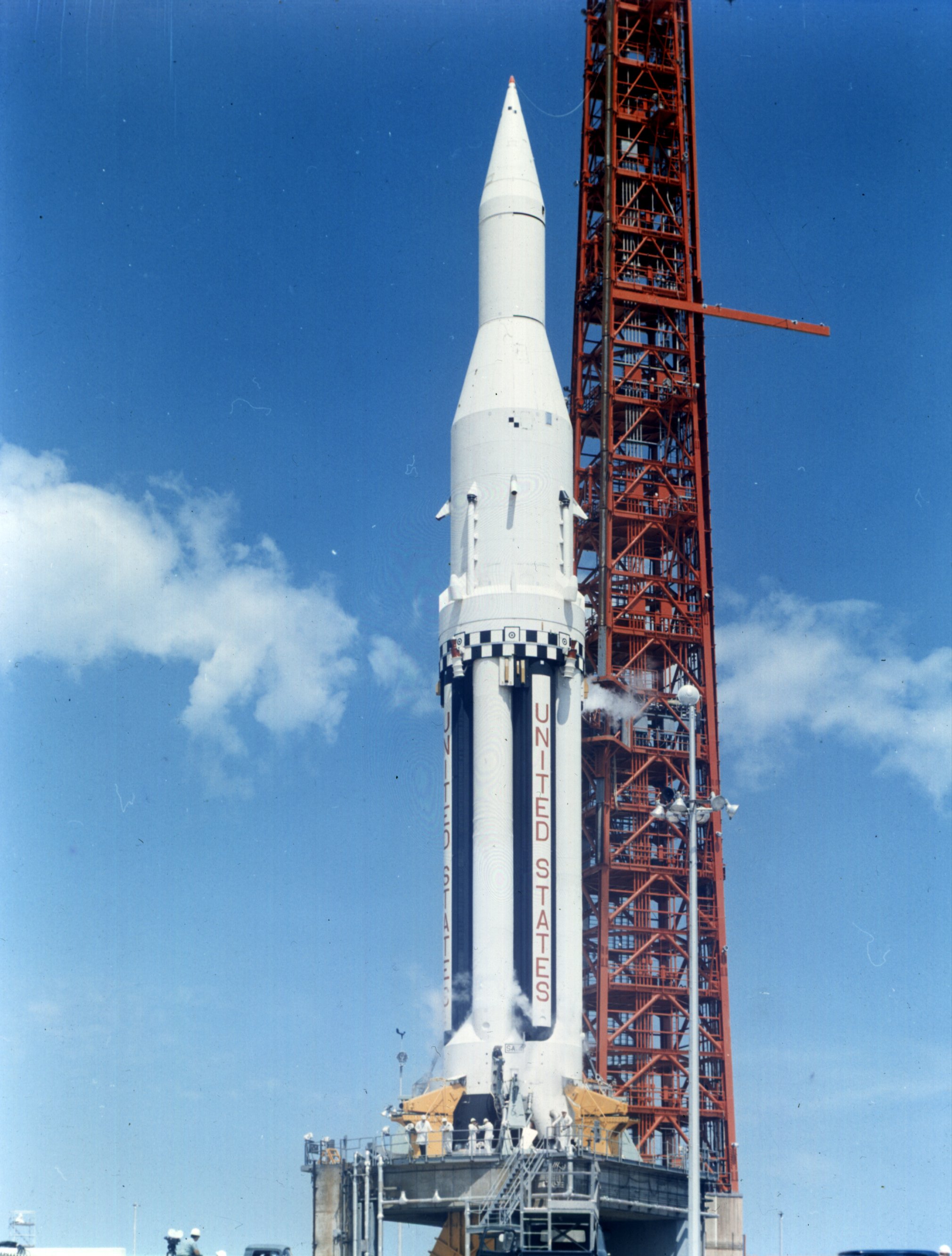
Saturn I
In-activeChrysler (CHR)
Oct. 27, 1961
Description
The Saturn I was a rocket designed as the United States' first medium lift launch vehicle for up to 20,000-pound (9,100 kg) low Earth orbit payloads.
Specifications
-
Minimum Stage
2 -
Max Stage
3 -
Length
55.0 m -
Diameter
6.6 m -
Fairing Diameter
6.6 m -
Launch Mass
510.0 T -
Thrust
6700.0 kN
Family
-
Name
Saturn I -
Family
― -
Variant
I -
Alias
― -
Full Name
Saturn I
Payload Capacity
-
Launch Cost
― -
Low Earth Orbit
9100.0 kg -
Geostationary Transfer
Orbit
― -
Direct Geostationary
― -
Sun-Synchronous Capacity
―
Chrysler
Commercial
None
CHR 1950In July 1959, NASA chose the Redstone missile as the basis for the Mercury-Redstone Launch Vehicle to be used for suborbital test flights of the Project Mercury spacecraft. Three unmanned MRLV launch attempts were made between November 1960 and March 1961, two of which were successful. The MRLV successfully launched the chimpanzee Ham, and astronauts Alan Shepard and Gus Grissom on three suborbital flights in January, May and July 1961, respectively.
Saturn I | Pegasus 3
Chrysler | United States of AmericaCape Canaveral SFS, FL, USA
July 30, 1965, 1 p.m.
Saturn I | Pegasus 2
Chrysler | United States of AmericaCape Canaveral SFS, FL, USA
May 25, 1965, 7:35 a.m.
Saturn I | Pegasus 1
Chrysler | United States of AmericaCape Canaveral SFS, FL, USA
Feb. 16, 1965, 2:37 p.m.
Saturn I | Saturn-SA 7
Chrysler | United States of AmericaCape Canaveral SFS, FL, USA
Sept. 18, 1964, 4:22 p.m.
Saturn I | Saturn-SA 6
Chrysler | United States of AmericaCape Canaveral SFS, FL, USA
May 28, 1964, 5:07 p.m.
Saturn I | Saturn SA-5
Chrysler | United States of AmericaCape Canaveral SFS, FL, USA
Jan. 29, 1964, 4:25 p.m.
Saturn I | Saturn SA-4
Chrysler | United States of AmericaCape Canaveral SFS, FL, USA
March 28, 1963, 8:11 p.m.
Saturn I | Saturn SA-3
Chrysler | United States of AmericaCape Canaveral SFS, FL, USA
Nov. 16, 1962, 5:45 p.m.
Saturn I | Saturn SA-2
Chrysler | United States of AmericaCape Canaveral SFS, FL, USA
April 25, 1962, 2 p.m.
Falcon 9
Starlink Group 10-41
Space Launch Complex 40 - Cape Canaveral SFS, FL, USAA batch of 29 satellites for the Starlink mega-constellation - SpaceX's project for space-based Internet communication system.
Falcon 9
Starlink Group 17-23
Space Launch Complex 4E - Vandenberg SFB, CA, USAA batch of 25 satellites for the Starlink mega-constellation - SpaceX's project for space-based Internet communication system.
Electron
That's Not A Knife (DART AE)
Rocket Lab Launch Complex 2 (Launch Area 0 C) - Wallops Flight Facility, Virginia, USAPayload is a scramjet-powered hypersonic vehicle developed by by Australian company Hypersonix.
Falcon 9
Starlink Group 6-108
Space Launch Complex 40 - Cape Canaveral SFS, FL, USAA batch of 29 satellites for the Starlink mega-constellation - SpaceX's project for space-based Internet communication system.
Falcon 9
Starlink Group 17-26
Space Launch Complex 4E - Vandenberg SFB, CA, USAA batch of 25 satellites for the Starlink mega-constellation - SpaceX's project for space-based Internet communication system.

