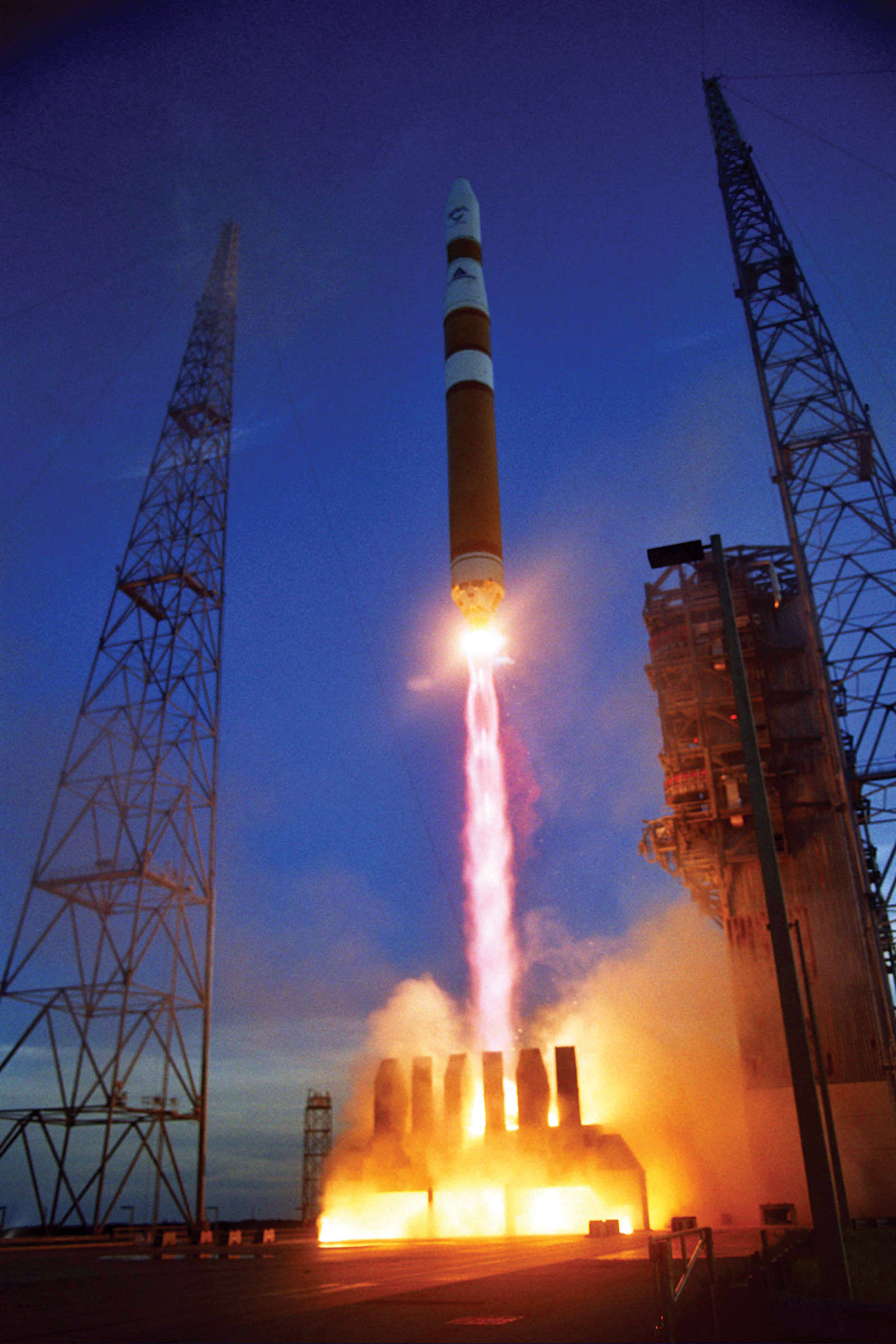
Delta IV M
In-activeUnited Launch Alliance (ULA)
March 11, 2003
Description
Delta IV is a group of five expendable launch systems in the Delta rocket family introduced in the early 2000s. Originally designed by Boeing's Defense, Space & Security division for the Evolved Expendable Launch Vehicle (EELV) program, the Delta IV became a United Launch Alliance (ULA) product in 2006. The Delta IV was and is primarily a launch vehicle for United States Air Force military payloads, but has also been used to launch a number of U.S. government non-military payloads and a single commercial satellite.
Specifications
-
Stages
2 -
Length
63.0 m -
Diameter
5.0 m -
Fairing Diameter
5.0 m -
Launch Mass
250.0 T -
Thrust
2890.0 kN
Family
-
Name
Delta IV M -
Family
― -
Variant
M -
Alias
― -
Full Name
Delta IV M
Payload Capacity
-
Launch Cost
$164000000 -
Low Earth Orbit
8600.0 kg -
Geostationary Transfer
Orbit
3900.0 kg -
Direct Geostationary
― -
Sun-Synchronous Capacity
―
United Launch Alliance
Commercial
Interim CEO: John Elbon
ULA 2006United Launch Alliance (ULA) is a joint venture of Lockheed Martin Space Systems and Boeing Defense, Space & Security. ULA was formed in December 2006 by combining the teams at these companies which provide spacecraft launch services to the government of the United States. ULA launches from both coasts of the US. They launch their Atlas V vehicle from LC-41 in Cape Canaveral and LC-3E at Vandeberg. Their Delta IV launches from LC-37 at Cape Canaveral and LC-6 at Vandenberg.
Delta IV M | DMSP F-17
United Launch Alliance | United States of AmericaVandenberg SFB, CA, USA
Nov. 4, 2006, 1:53 p.m.
Delta IV M | DSCS III B-6
United Launch Alliance | United States of AmericaCape Canaveral SFS, FL, USA
Aug. 29, 2003, 11:13 p.m.
Delta IV M | DSCS III A-3
United Launch Alliance | United States of AmericaCape Canaveral SFS, FL, USA
March 11, 2003, 12:59 a.m.
Status: Launch Successful
Mission:
The U.S. Air Force Space Command operates 10 Phase III DSCS satellites providing defense officials and battlefield commanders secure voice and high rate data communications. The DSCS III system also transmits space operations and early warning data to various systems and users.
Geostationary Transfer OrbitAtlas V 551
Amazon Leo (LA-05)
Space Launch Complex 41 - Cape Canaveral SFS, FL, USAAmazon Leo, formerly known as Project Kuiper, is a mega constellation of satellites in Low Earth Orbit that will offer broadband internet access, thi…
Soyuz 2.1a/Fregat-M
Meridian-M No.21L
43/3 (43L) - Plesetsk Cosmodrome, Russian FederationNote: Payload identity uncertain. Meridian is a series of communications satellite for military and civilian use.
Tianlong-3
Demo Flight
Tianlong-3 Launch Pad - Jiuquan Satellite Launch Center, People's Republic of ChinaFirst test launch of Space Pioneer’s Tianlong-3 rocket.
Falcon 9
Starlink Group 10-58
Space Launch Complex 40 - Cape Canaveral SFS, FL, USAA batch of 29 satellites for the Starlink mega-constellation - SpaceX's project for space-based Internet communication system.
Space Launch System (SLS)
Artemis II
Launch Complex 39B - Kennedy Space Center, FL, USAArtemis II is the first crewed mission as part of the Artemis program. Artemis II will send a crew of 4 - 3 Americans and 1 Canadian around the moon …

