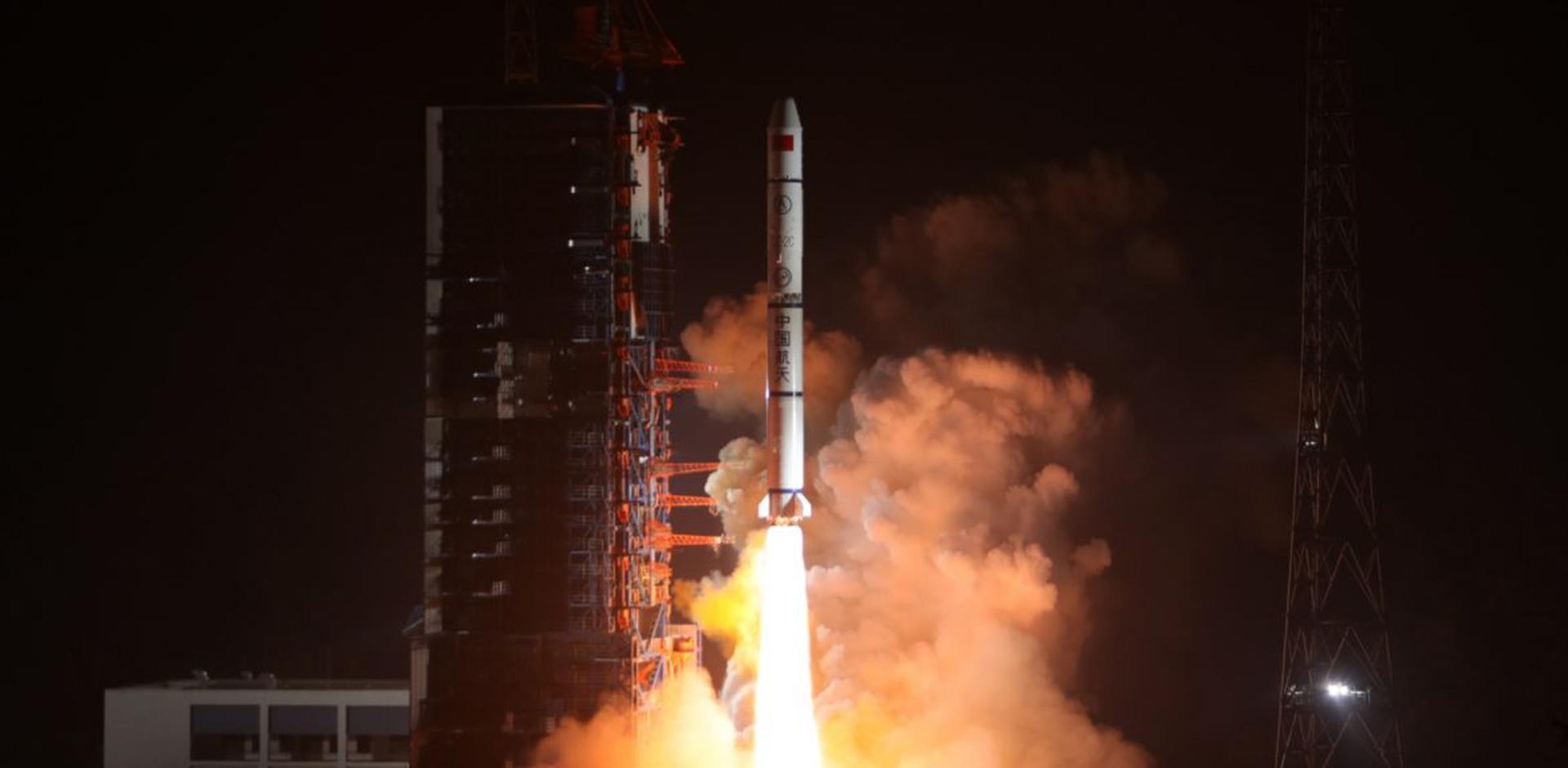
Long March 2C/SMA
In-activeChina Aerospace Science and Technology Corporation (CASC)
Sept. 6, 2008
Description
The Long March 2C is a family of expendable launch vehicles made and operated by China. It is a two stage launch vehicle with storable propellants, consisting of Nitrogen Tetroxide and Unsymmetrical Dimethylhydrazine.
Specifications
-
Length
― -
Diameter
― -
Fairing Diameter
― -
Launch Mass
― -
Thrust
―
Family
-
Name
Long March 2C/SMA -
Family
― -
Variant
C/SMA -
Alias
― -
Full Name
Long March 2C/SMA
Payload Capacity
-
Launch Cost
― -
Low Earth Orbit
― -
Geostationary Transfer
Orbit
― -
Direct Geostationary
― -
Sun-Synchronous Capacity
―
China Aerospace Science and Technology Corporation
Government
Chairman & President: Lei Fanpei
CASC 1999The China Aerospace Science and Technology Corporation (CASC) is the main contractor for the Chinese space program. It is state-owned and has a number of subordinate entities which design, develop and manufacture a range of spacecraft, launch vehicles, strategic and tactical missile systems, and ground equipment. It was officially established in July 1999 as part of a Chinese government reform drive, having previously been one part of the former China Aerospace Corporation. Various incarnations of the program date back to 1956.
Long March 2C/SMA | PRSS-1 & PakTes-1A
China Aerospace Science and Technology Corporation | ChinaJiuquan Satellite Launch Center, People's Republic of China
July 9, 2018, 3:56 a.m.
Status: Launch Successful
Mission:
The Pakistan Remote Sensing Satellite (PRSS) is a dual purpose Earh observation and optical satellite. It is to operate in sun-synchronous orbit with a planned lifetime of 5 years. PakTes-1A is a remote sensing satellite built by Pakistan's space agency with assistance from Space Advisory Company of South Africa.
Sun-Synchronous OrbitLong March 2C/SMA | Shijian 9A & Shijian 9B
China Aerospace Science and Technology Corporation | ChinaTaiyuan Satellite Launch Center, People's Republic of China
Oct. 14, 2012, 3:25 a.m.
Falcon 9
Starlink Group 10-36
Space Launch Complex 40 - Cape Canaveral SFS, FL, USAA batch of 29 satellites for the Starlink mega-constellation - SpaceX's project for space-based Internet communication system. First Starlink laun…
Falcon 9
Starlink Group 6-103
Space Launch Complex 40 - Cape Canaveral SFS, FL, USAA batch of 29 satellites for the Starlink mega-constellation - SpaceX's project for space-based Internet communication system.
Falcon 9
Starlink Group 17-13
Space Launch Complex 4E - Vandenberg SFB, CA, USAA batch of 24 satellites for the Starlink mega-constellation - SpaceX's project for space-based Internet communication system.
Falcon 9
Crew-12
Space Launch Complex 40 - Cape Canaveral SFS, FL, USASpaceX Crew-12 is the twelfth crewed operational flight of a Crew Dragon spacecraft to the International Space Station as part of NASA's Commercial C…
Ariane 64
Amazon Leo (LE-01)
Ariane Launch Area 4 - Guiana Space Centre, French GuianaAmazon Leo, formerly known as Project Kuiper, is a mega constellation of satellites in Low Earth Orbit that will offer broadband internet access, thi…

