Previous Spaceflight Launches

Filter by Agency, Locations or Vehicles

Show All Launches
Full Launch History

View all launches available - including launches from the past and utilize powerful search filters.

Zhuque-3 | Demo Flight

LandSpace | China
Jiuquan Satellite Launch Center, People's Republic of China
Dec. 3, 2025, 4 a.m.
Status: Launch Successful
Mission:

First test launch of LandSpace’s ZQ-3 rocket, with a dummy payload. The rocket’s 1st stage attempted to land on a landing pad about 300 km downrange of the launch site.

Low Earth Orbit ZQ-3 F1 - Maiden Flight Zhuque-3 Landing Site
Explore Share

Falcon 9 Block 5 | Starlink Group 6-95

SpaceX | United States of America
Cape Canaveral SFS, FL, USA
Dec. 2, 2025, 10:18 p.m.
Status: Launch Successful
Mission:

A batch of 29 satellites for the Starlink mega-constellation - SpaceX's project for space-based Internet communication system.

Low Earth Orbit B1077 - Flight Proven ( ) A Shortfall of Gravitas
Explore Share

Falcon 9 Block 5 | Starlink Group 15-10

SpaceX | United States of America
Vandenberg SFB, CA, USA
Dec. 2, 2025, 5:28 a.m.
Status: Launch Successful
Mission:

A batch of 27 satellites for the Starlink mega-constellation - SpaceX's project for space-based Internet communication system.

Low Earth Orbit B1081 - Flight Proven ( ) Of Course I Still Love You
Explore Share

Vega-C | KOMPSAT-7

Avio S.p.A | Italy
Guiana Space Centre, French Guiana
Dec. 1, 2025, 5:21 p.m.
Status: Launch Successful
Mission:

KOMPSAT-7 is the follow-up model of KOMPSAT-3A whose mission is to provide high-resolution satellite images to satisfy South-Korea's governmental and institutional needs.

Sun-Synchronous Orbit VV28
Explore Share

Falcon 9 Block 5 | Starlink Group 6-86

SpaceX | United States of America
Kennedy Space Center, FL, USA
Dec. 1, 2025, 7:44 a.m.
Status: Launch Successful
Mission:

A batch of 29 satellites for the Starlink mega-constellation - SpaceX's project for space-based Internet communication system.

Low Earth Orbit B1095 - Flight Proven ( ) Just Read the Instructions
Explore Share

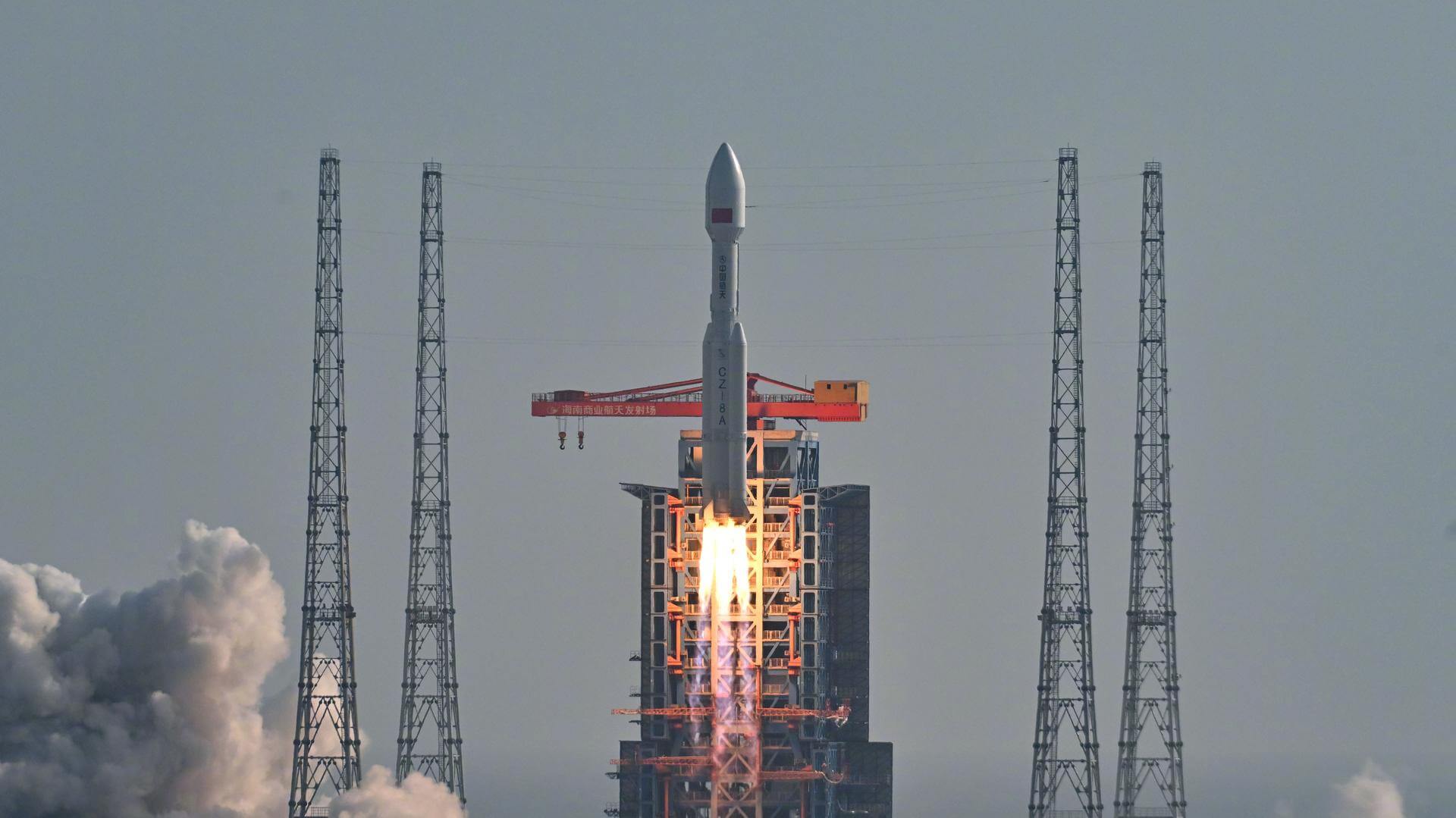
Long March 7A | Shijian 28

China Aerospace Science and Technology Corporation | China
Wenchang Space Launch Site, People's Republic of China
Nov. 30, 2025, 12:20 p.m.
Status: Launch Successful
Mission:

Classified experimental Chinese satellite of unknown purposes.

Geostationary Transfer Orbit
Explore Share

Falcon 9 Block 5 | Transporter 15 (Dedicated SSO Rideshare)

SpaceX | United States of America
Vandenberg SFB, CA, USA
Nov. 28, 2025, 6:44 p.m.
Status: Launch Successful
Mission:

Dedicated rideshare flight to a sun-synchronous orbit with dozens of small microsatellites and nanosatellites for commercial and government customers.

Sun-Synchronous Orbit B1071 - Flight Proven ( ) Of Course I Still Love You
Explore Share

Soyuz 2.1a | Soyuz MS-28

Progress Rocket Space Center | Russia
Baikonur Cosmodrome, Republic of Kazakhstan
Nov. 27, 2025, 9:27 a.m.
Status: Launch Successful
Mission:

Soyuz MS-28 will carry three cosmonauts and one astronaut to the International Space Station aboard the Soyuz spacecraft from the Baikonur Cosmodrome in Kazakhstan. The crew consists of Roscosmos cosmonauts Sergei Kud-Sverchkov, Sergei Mikayev and Oleg Platonov.

Low Earth Orbit
Explore Share

Nuri | CAS500-3

Korea Aerospace Research Institute | South Korea
Naro Space Center, South Korea
Nov. 26, 2025, 4:13 p.m.
Status: Launch Successful
Mission:

CAS500-3 is a South Korean Earth observation satellites to be used by the Ministry of Science and ICT for space technology verification and space science research.

Sun-Synchronous Orbit
Explore Share

Angara 1.2 | 3 x Rodnik (Kosmos 2597, 2598, 2599)

Khrunichev State Research and Production Space Center | Russia
Plesetsk Cosmodrome, Russian Federation
Nov. 25, 2025, 1:42 p.m.
Status: Launch Successful
Mission:

Note: Payload identity and Cosmos series numbering not confirmed. The Strela (Russian: Стрела) are Soviet, then Russian, military space telecommunication satellites, in use since 1964. These satellites operate as mailboxes ("store-and-forward"): they remember the received messages and then resend them after the scheduled time, or by a command from the Earth. They can serve for up to five years. The satellites are used for transmission of encrypted messages and images. The operational constellation consists of 12 satellites in two orbital planes, spaced 90° apart. The spacecraft had a cylindrical body with a gravity-gradient boom, which was extended on-orbit to provide passive attitude stabilization. On-board storage was 12 Mbits of data, with a transmission rate of 2.4 kbit/s. The first three satellites were launched in 1964 by a Cosmos launcher. After one year of service, new and improved satellites were launched, called Strela-2. In 1970, these satellites were modernized, and became the Strela-1M and Strela-2M satellites. From 1985, these satellites will be gradually replaced by Strela-3, and then by Strela-3M from 2005. A civilian version of these satellites was created, called Goniets. Initially they were launched in groups of six on Tsyklon; when the launcher was retired, they were only launched by two on Cosmos, before Rokot was put into service and allowed the sending of triplets of Strela satellites.

Low Earth Orbit
Explore Share